


Published
In this guest blog, Mark Coates, Senior International Director of Infrastructure Policy Advancement at Bentley Systems, examines whether the infrastructure is keeping up with the growth of EVs in the UK.
It may be easy to forget now, but the first major electric vehicle (EV) launch in the United Kingdom was a spectacular failure.
Before Elon Musk, there was Sir Clive Sinclair. Before the Tesla, there was the C5.
The C5—a three-wheeled hybrid car-bike powered by a 12-volt lead-acid battery—was launched to great fanfare in 1985. It flopped. Horribly. It was mocked by the media and public, and full-scale production was halted just three months after the launch. Within another five months, the vehicle had disappeared completely. Of the 14,000 C5s that were manufactured, only 5,000 were sold.
It has become fashionable to say that the C5 was an “idea ahead of its time”, which is true but does not tell the whole story. Among the C5’s problems was a poor design—including the complete lack of waterproofing and the absence of a reverse gear.
However, the main problem was not the concept, but rather the state of technology at the time. The limitations of 1980’s batteries meant the C5 had a range of just 20 miles and a top speed of only 15 miles per hour. The batteries also lost charge in cold weather.
As a result, the C5 never really had a market. It did not solve the problems of any particular set of customers. It was pitched as a form of commuter transport somewhere between the car and the bike; but rather than combining the best bits of both, it combined their limitations.
What Sir Clive clearly understood was that, in the long term, the battery would replace the internal-combustion engine—and that this revolutionary change, once it began, would happen very quickly. It is gratifying to think that by the time Sir Clive died in September 2021, his instincts had been proven right. The technology surrounding EVs had well and truly caught up with the concept. As a result a market had emerged—not at a trickle, but at a flood.
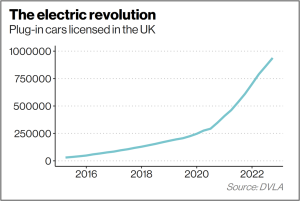
In April 2015, according to the Driver and Vehicle Licensing Agency (DVLA), there were around 30,031 plug-in cars licensed for use on the U.K.’s roads. A year later, that number had almost doubled to 59,226. By April 2020, there were 275,824.
In the past two years, we have seen impressive growth. By October 2022, there were 938,182 plug-in cars on the road. In the third quarter of that year alone, 60,335 new battery-only plug-in cars were registered for the first time for use on U.K. roads—nearly twice as many as the 32,770 diesels.
Neither is this a purely European phenomenon. The latest edition of the International Energy Agency’s global electric vehicle outlook found more than 10 million electric cars were sold worldwide in 2022, with a further 35% growth expected this year. The total market share of electric cars has jumped from 4% in 2020 to an expected 18% this year. Some 60% of global sales take place in China; in the United States, sales were up 55% in 2022.
Technology is no longer a constraining factor as it was in the days of the C5. However, given the sheer speed with which EVs are taking over the market, infrastructure might be another matter.
While the number of new EVs has been increasing exponentially, the number of public charging points has not. The latest Department for Transport data suggests that, as of January this year, there were 37,055 across the country. Fewer than one in five of these are classed as “rapid” or above, meaning that they charge at least 25 kilowatts (kW) and can typically add around 100 miles of range in half an hour. Around three in five of the U.K.’s chargers are classed as “fast,” which means at least 7 kW. Despite the name, a 7-kW charger takes around eight hours to fully recharge an empty car battery. Two in five public chargers are slower than that.
The public network is, therefore, very much targeted towards “top ups,” with the presumption most people will then charge their cars at home overnight. Generous subsidies have been available for home charging points, but they are not practical for everyone, particularly people who live in flats or on crowded streets with no off-street parking. More than a third of households do not have the option of off-street parking, according to the Climate Change Committee (CCC), the government’s independent advisor on climate change and energy transition.
The average range of a modern EV is around 211 miles, which is much higher than a few years ago. However, it still means that people undertaking long journeys are going to need the public charging network, no matter how long they spend plugged in at home.
The data shows that the number of public charge points in the U.K. rose by 8,680 in the year to January, an increase of 31%. It sounds impressive until you consider that the number of new plug-in cars is increasing twice as fast. Neither is that a new phenomenon. Between 2015 and 2020, the number of new EVs and public charging points rose at a roughly similar rate. Since then, the two trajectories have rapidly diverged.
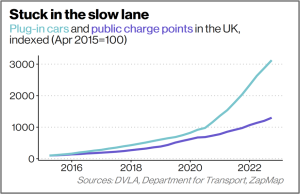
Now, there is more competition than ever for a limited number of generally underpowered chargers. The lower the power of the charger, the longer it is likely to be occupied by a single user, making it unavailable to everyone else.
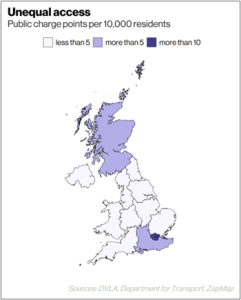
The problem is also not spread evenly across the country. London has nearly a third of the U.K.’s public charging points, but less than one-fifth of its population.
Across the U.K., there are 5.5 charge points for every 10,000 people. In London, there are 13.1 for every 10,000 people—a number that rises even higher in central London boroughs. Compare that to the North West of England, which has just 3.1 public charge points for every 10,000 residents, or Yorkshire and the Humber, which has 3.6. Northern Ireland has it even worse, with just 366 charge points in total. That works out as 1.9 for every 10,000 residents.
The government is aware of these problems and under pressure to provide an adequate response. Last year, it published “Taking Charge,” its strategy for public charging infrastructure. It contained two major interventions. One was a GBP 950 million “Rapid Charging Fund” to ensure sufficient capacity on the strategic road network (including at least six rapid chargers at each motorway service area by the end of this year) and 6,000 high-powered chargers on the network by 2035.
The second was a new obligation on local authorities to develop and implement local charging strategies, which must identify “how to provide affordable, convenient charging” for residents and businesses.
Environmental groups grumble that the government has gone quiet on the Rapid Charging Fund since them. There were no new commitments in the March budget, although Energy Secretary Grant Shapps did pledge a further GBP 380 million into boosting EV charging infrastructure later that month.
The question is whether any of these strategies are sufficient to achieve what the government says it wants to achieve. It remains committed to ending the sale of new petrol and diesel cars by 2030. Demand is unlikely to stall, as battery technology (and range) continues to improve. In addition, EV prices continue to fall due to cheaper component prices, greater competition among manufacturers, and an emerging second-hand market that is forcing new-car prices downward.
Failing to improve the infrastructure fast enough could slow this transition, as well as having productivity costs for people left waiting in line for insufficient chargers.
The CCC has estimated around 280,000 new charge points will be required by 2030—or roughly 30,000 a year—to hit government targets. In 2022, fewer than 10,000 were added. Deloitte estimates that hitting the government target will require up to GBP 18 billion of new investment. A smooth transition will not be cheap; but failure, in the long-term, could be much more costly.

A former quantity surveyor with an extensive background in global project delivery, Mark first began working in the construction sector 33 years ago. He has worked with Thames Water, United Utilities, ICI, Highways England, The Olympic Delivery Authority, and Crossrail.
For the past ten years, Mark has been working in digital transformation and has seen the great advances made in sectors by adopting digital ways of working. He has worked on numerous infrastructure projects, consulting asset owners and their advisors on technology adoption to attain better project results while being conscious of time, cost, and quality.
Mark is a Fellow of the Chartered Institution of Highways and Transportation and recently served as vice-chairman and chairman of the British Water Forum for the last two years. Mark also serves on the Strategic Board of the UK’s Digital Twin Hub and is a member of the Institute of Government and Public Policy’s advisory board.