


Published
In this guest blog, Mark Coates, Senior International Director of Infrastructure Policy Advancement at Bentley Systems, explores the environmental and economic race to net zero.
July marks four years since the United Kingdom became the first major economy to pass a net-zero emissions law.
The target required the U.K. to bring all greenhouse gas emissions to net zero by 2050 — a significant upgrade of a previous undertaking to merely reduce emissions by 80%, compared to 1990 levels.
Announcing the measure, Chris Skidmore, the minister for energy and clean growth in Boris Johnson’s government, said, “The U.K. kickstarted the Industrial Revolution, which was responsible for economic growth across the globe but also for increasing emissions.
“Today, we’re leading the world yet again in becoming the first major economy to pass new laws to reduce emissions to net zero by 2050 while remaining committed to growing the economy — putting clean growth at the heart of our modern industrial strategy.”
Skidmore was back in the headlines earlier this year. Now a backbench MP, he had been commissioned by Liz Truss during her short tenure as prime minister to review the way that the government was meeting its net-zero targets. His report, published in January, said that the U.K. should be proud of the steps that it had taken so far to achieve net zero. But it also warned that more action was needed by government and industry to maximise the economic opportunity presented by “clean growth.”
The report warned that the U.K. was “not matching world-leading ambition with world-leading delivery”, saying that consistent long-term policy — and investment — would be necessary to deliver economic rewards.
Skidmore pointed to other countries that had staged “bold and ambitious” interventions, including the United States, Germany, and France. He stressed that the U.K. was in a global competition with other countries that had also recognised the market shift and were keen to take advantage.
The report, which had a total of 129 recommendations, urged the government to provide incentives for investment alongside wider opportunities for job creation and local regeneration.
The point that Skidmore clearly recognised is that net zero is a race with multiple dimensions.
Looked at in one way, it is an environmental race against the clock. The U.K. faces a clear — and taxing — deadline to reduce net emissions by 100%. The government has also introduced an interim target of reducing emission by 78% by 2035.
Meeting these targets is far from assured and will require concerted year-on-year effort. In an economy driven by consumption, reducing net emissions by even a small amount is hard. As Skidmore has pointed out, this effort cannot be back ended — we will not meet the 2050 target unless we first meet the 2035 target, and we will not meet it unless we make concerted efforts right now.
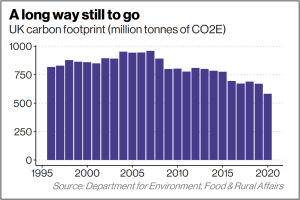
The U.K.’s “carbon footprint” — total greenhouse gas emissions associated with consumption — peaked as recently as 2007 at 959 million tonnes of carbon dioxide equivalent. That amount fell to just 800 million tonnes in 2009. It was an impressive achievement, but one that arguably had a great deal to do with the global economic slump rather than concerted environmental action.
By 2016, the carbon footprint was down to 695 million tonnes, but in the following three years, the rate of decrease fell away sharply. By 2019, the U.K.’s carbon footprint still stood at 670 million tonnes, and while it dropped to 583 million tonnes in 2020, when the pandemic caused massive economic disruption that year. Communities were locked down, commuting to work became the exception rather than the rule, and air travel was highly restricted. And still, the U.K.’s carbon footprint fell just 13%, year-on-year.
But net zero is not just an environmental race against the clock. It is also an economic race against every other country in the world. Not every country will be as successful in creating or attracting the companies that build the batteries, wind turbines, solar panels, and small nuclear reactors that power the energy transition; not every country will prosper equally from high-value research and development that optimises technical solutions to environmental challenges, or the service industries that help businesses and governments adapt.
The United States’ muscular approach has made the world sit up and take notice. For years, American governments had eschewed interventionist industrial policy, relying instead on a combination of global trade and a light-touch approach to a vibrant, entrepreneurial domestic private sector. But then, the Inflation Reduction Act came in 2022 — a landmark law that will provide GBP 369 billion of grants, loans, and tax credits to support clean growth industries over the next decade.
The advantages to the U.S. are multifaceted. Environmentally, the Inflation Reduction Act will help the country meet net zero targets more quickly. Politically, it will reduce trade dependence on China during a period of high tension. Economically, it puts the U.S. in position to create millions of new jobs in critical clean growth industries — such as the manufacture of batteries, wind turbines, and solar panels.
Central to the Inflation Reduction Act is a condition that if a company wishes to benefit from tax credits, production and final assembly must be based in the U.S. Other countries have complained bitterly about this condition, fearing not only that they will miss out on potential new jobs, but that companies might be tempted to relocate — taking existing jobs with them too.
It is no idle threat. Industries like carbon capture and clean hydrogen remain in their infancy; they are developing quickly and face a great deal of uncertainty and risk. The sheer generosity of the Inflation Reduction Act — and the agglomeration benefits of the clusters of excellence that it stands to create — are very real temptations.
The European Union was spooked enough to promise a “massive” Green Deal Industrial Plan in response, including a more flexible approach to state aid and a European Sovereignty Fund to finance multicountry projects vital to the energy transition. These measures have proved controversial among many member states, including smaller and poorer ones who believe more flexible state aid will chiefly benefit companies in Germany and France. Nonetheless, they reflect just how seriously the EU considers the Inflation Reduction Act.
For the U.K., the options are more limited. There is clearly no political appetite among senior conservatives for large-scale subsidies, which would be dwarfed by what the U.S. or Europe could offer. Chancellor Jeremy Hunt has suggested that the U.K. will focus on building a regulatory structure that encourages creativity and innovation. Although, his announcement in March of GBP 20 billion support for carbon capture and low energy projects, albeit spread over two decades, suggests an awareness that at least some capital funding will be necessary.
The Labour Party — who polls suggest are the most likely winners of a 2024 general election — have largely talked a good game on clean growth, touting their “Green Prosperity Plan” as a U.K. version of the Inflation Reduction Act. The plan is to inject GBP 28 billion of (borrowed) capital into the green economy each year—which, the party says, would attract additional private sector investment and benefit the entire country. It is Labour’s biggest current spending commitment, something which has provoked internal party tension since it leaves the party apparently little room to pay for other priorities, such as housing and transport. Recently, Shadow Chancellor Rachel Reeves has watered down the commitment, saying Labour would not invest GBP 28 billion initially, but rather “scale up” to GBP 28 billion by 2027 to be “responsible” with public finances. Such is politics: there is no guarantee the policy will not change again before the next election.
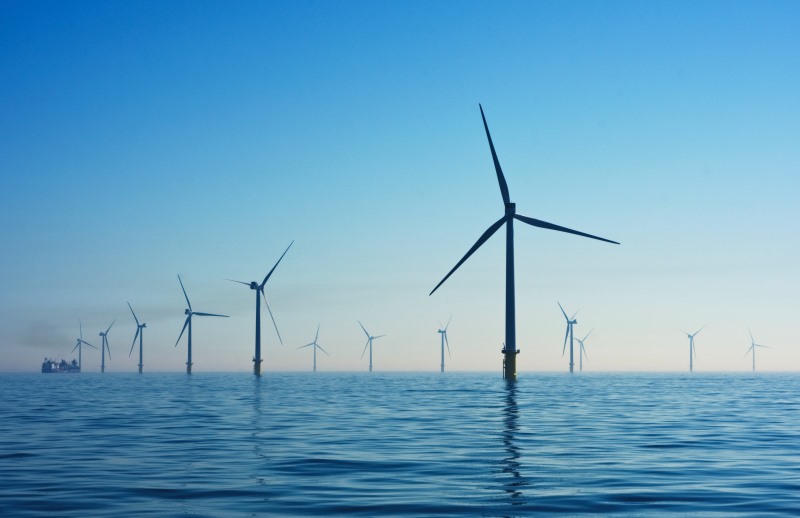
The good news for the U.K. is that it has certain advantages that give it a head start over potential global rivals. One advantage is the country’s geography and climate. Access to the blustery North Sea has allowed the U.K. to become a global leader in offshore wind. Until last year, the U.K. had the most installed offshore wind capacity in the world. Even now, it is second behind only China. Another advantage is that U.K. continues to have world-ranked universities that bely its size.
There is no doubt that the U.K. will benefit from green jobs in the coming years. The issue is whether it maximises those gains. The country will not lose the green jobs race — but it might not win it either.

A former quantity surveyor with an extensive background in global project delivery, Mark first began working in the construction sector 33 years ago. He has worked with Thames Water, United Utilities, ICI, Highways England, The Olympic Delivery Authority, and Crossrail.
For the past ten years, Mark has been working in digital transformation and has seen the great advances made in sectors by adopting digital ways of working. He has worked on numerous infrastructure projects, consulting asset owners and their advisors on technology adoption to attain better project results while being conscious of time, cost, and quality.
Mark is a Fellow of the Chartered Institution of Highways and Transportation and recently served as vice-chairman and chairman of the British Water Forum for the last two years. Mark also serves on the Strategic Board of the UK’s Digital Twin Hub and is a member of the Institute of Government and Public Policy’s advisory board.