


Published
In this guest blog, Mark Coates, Vice President of Infrastructure Policy Advancement at Bentley Systems, believes that while health and safety on construction sites needs to remain a top priority of the industry, the construction industry’s next mega project needs to be a focus on mental health.

Construction and infrastructure are some of the largest industry employers in the U.K.
As of the fourth quarter of 2023, there were approximately 2.12 million of us employed in the construction sector in the U.K., according to Statista.
There are more of us working in the U.K. construction sector than the populations of major European cities, such as Paris, Barcelona, and Vienna, and almost as many as the population of Houston, the fourth most populated city in the United States.
When you look at the value that we drive, the construction sector — encompassing contracting, product manufacturing and professional services — had a turnover of around GBP 370 billion in 2016. The construction sector also has the largest number of self-employed people in the U.K. economy.
It’s a dynamic industry with a transient workforce that I’m proud to be part of.
The transient nature of our industry is dictated by its economic drivers: the project and — as I have been fortunate to experience on Crossrail, at one point Europe’s largest civil engineering scheme — the mega project.
Our projects help build national economies and make national and international headlines. However, despite its size and value, the construction sector has a reputation of being worse for worker well‐being than other sectors.
The sector has made great strides in health and safety over the past 50 years. To highlight the impact that better health and safety legislation has made, it is worth reflecting that in 1975, the number of construction workers who lost their lives at work was 182.
By 2004-2005, it was 69. In the years between 2014-2015 and 2020-2021, when Construction News published this piece, the number of deaths each year has averaged about 36 — a fall of 80%. The number of non-fatal injuries remains much higher but has actually fallen slightly faster, from around 35,000 construction workers hurt each a year in the mid-70s to around 4,500 in 2019-2020 — a decline of more than 87%.
The fall in the number of deaths and injuries has been achieved despite the face we have more people working in the sector – 1.97m people worked in the construction sector in 1975 compared to 2.12m in the fourth quarter of 2023.
There is still much for our sector to do to reduce the number of deaths and injuries further and strive towards zero accidents. One of the concerning statistics on workforce wellbeing is the fact that in 2021, 507 construction workers took their own life. This is almost equivalent to us losing two members of our industry every working day.
According to data from the Office for National Statistics (ONS), workers in construction are now nearly four times more likely to die by suicide than in any other sector.
As I write this, I’m reminded of reading a story in The Construction Index last year, which flagged that while the pandemic might have increased deaths in 2021, the five-year average of construction workers taking their own life was 482. When you look at this data closely, it shows that 13 times more construction workers took their own lives rather than lost their lives on site.
While health and safety on site needs to remain a top priority of the industry, perhaps the industry’s next mega project needs to be a focus on mental health.
In June 2022, Mates in Mind published its findings from a major study of the mental health of self-employed construction workers and those working in small firms.
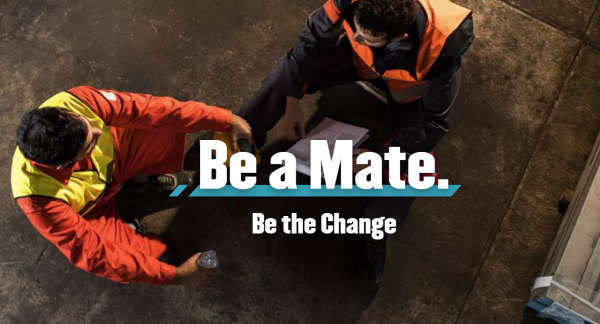
The report entitled “Supporting the mental health of self-employed construction workers” showed intense workloads, financial problems, poor work-life balance, and pandemic pressures on the supply of materials combined to significantly raise stress and anxiety levels.
The report also highlights that the nature of our industry itself makes things a challenge: the process of competitive tendering to win projects can create unstable work environments, while project delivery can require workers to undertake long hours on construction sites—combined with long and unpredictable supply chains and a transient and fragmented workforce.
In construction, relative to other sectors, there is a predominance of young, male workers with relatively low educational attainment and low job security, which are risk factors for mental illness and self-harm.
A 2020 study by CITB, based on interviews with 500 construction employees, found 97% had experienced stress over the past year, and more than one in four experienced suicidal thoughts.
Researchers from Mates in Mind and the Institute for Employment Studies (IES) found that when they surveyed 300 people working in the construction sector, almost a third were living with elevated levels of anxiety each day.
Furthermore, construction workers from a range of trades — including bricklayers, groundworkers and plasterers — told researchers that the continuing stigma of mental illness prevents them from discussing it beyond close friends or family members.
Despite a record number of women working in construction, the majority of those employed in the construction sector are men. For too long, men have been reluctant to talk about their mental health.
A 2022 survey by The Priory found that:
- More than three-quarter of men (77%) have suffered with symptoms of common mental health conditions such as anxiety, stress, or depression.
- 40% of men have never spoken to anyone about their mental health.
- 29% of those say they are “too embarrassed” to speak about it, while 20% say there is a “negative stigma” on the issue
- The biggest cause of mental health issues in men’s lives are work (32%), their finances (31%), and their health (23%)
Creating an integrated stable culture in construction projects can be difficult due to changing participants, including personnel working for clients, contractors, and subcontractors moving in and out of the project, as well as the challenges of time and budgetary pressures and the historically adversarial mindset of construction where legal disputes can arise between contractors, subcontractors and clients.
A 2023 research paper by Stewart Clegg, Martin Loosemore, Derek Walker, Alfons van Marrewijk, and Shankar Sankaran highlights that “projects attuned to reflection and organisation learning are clearly better places in which to work as well as being more likely to produce better project outcomes.”
Creating a learning culture within an organisation helps to identify and address knowledge gaps that constrain performance. Learning cultures identify valuable knowledge that already exists within a team and creates mechanisms to share it with colleagues, with a focus on action to drive change.
Mental health challenges are an obvious impediment which constrain project performance. Unfortunately, they are also challenges too many of us feel too awkward and embarrassing to share. Creating a commitment to learning should extend to a commitment to learning more about mental health and the benefits that it can unlock for people and organisations.
Reading this piece by Mental Health First Aiders England informed me that more than 55% of employees at Skanska UK have been trained in the MHFA England Mental Health Aware course or as Mental Health First Aiders. It has been a KPI for all line managers and executive staff to attend MHFA England training.
Perhaps our sector should adopt an industry-wide KPI to raise awareness and drive change to help of our colleagues and co-worker’s struggling with mental health issues. Crucially, this support needs to be extended to the self-employed people working in the sector too.
Infrastructure mega projects exist to transform lives and the lives of communities. As a sector, our next national mega project should be to help transform the lives of those who live and work inside our construction and infrastructure community.
We need to make it normal to learn and talk about mental health.

Mark, a former quantity surveyor with vast experience in worldwide project execution, began working in the construction industry 35 years ago. Among others, he has worked for Thames Water, United Utilities, ICI, Highways England, The Olympic Delivery Authority, and Crossrail.
Mark has been working in digital transformation from a delivery and financial perspective for the past 12 years and has experienced the incredible gains made in sectors by embracing digital ways of working. He has worked on various infrastructure projects, advising asset owners and their advisers on technology adoption to attain better project results while being conscious of time, cost, and quality.
Mark is a Fellow of both the Chartered Institution of Highways and Transportation as well as the Chartered Institution of Civil Engineering Surveyors. For the past two years, Mark has served as vice-chairman and chairman of the British Water Forum. Mark also serves on the Strategic Board of the UK’s Digital Twin Hub, is on the advisory board of the Institute of Government and Public Policy.