


Published
Andy Murray, Executive Director of the Major Projects Association, reflects on the thought-provoking Prestige Lecture 2024 held at the Institution of Civil Engineers in London on 11th June 2024.
With a record-breaking 50+ countries across the globe having elections in 2024 involving more than 2bn people in what Times Magazine is calling the ‘Ultimate Election Year’, the Major Projects Association chose the “politics of projects” as the topic for this year’s Prestige Lecture.
Hot off the back of giving the annual Reith Lectures, Professor Ben Ansell stepped up to the task of helping us tackle the challenge of politics head on. With impeccable timing, our lecture was bang in the middle of the UK General election, with three weeks down and three weeks to go to polling day. Sadly, it meant that some of our members from the civil service were unable to join us due to purdah guidance – but they will be able to see the full recording of Ben’s talk below.
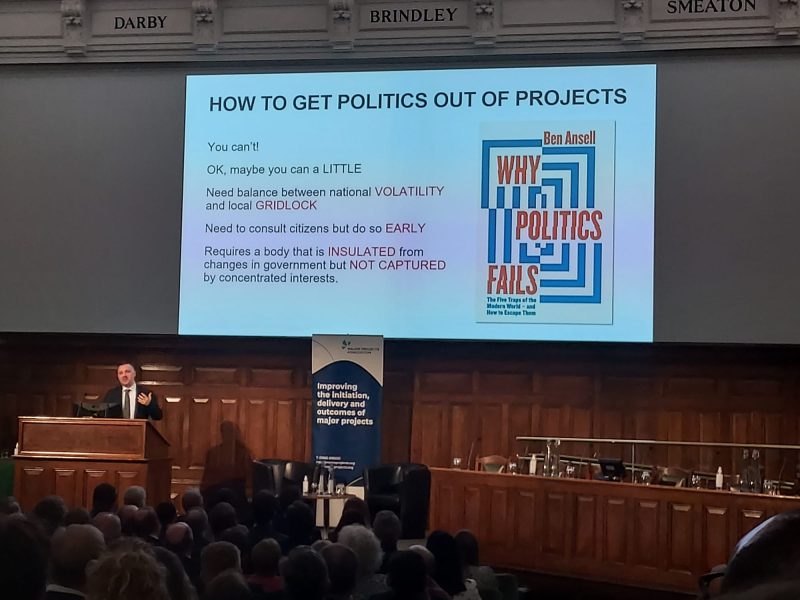
Ben started by highlighting the inherent mismatch between long-term decision making required to maximise the benefits for major projects, particularly infrastructure, and the short-term pressures that politicians at local, regional and national levels face. Bluntly, the long infrastructure cycle and the shorter political cycle, which can be weekly in terms of politics shows and newspaper columns, are in conflict. Ben went on to explain that there are other factors which can add further tensions such as the degree of centralisation, a single party majority, where countervailing checks and balances are limited and where ‘veto players’ are driven by narrow interests rather than broader national interests. Regarding the last point, Ben shared insights from public opinion that shows the public are generally in support of major projects, including housing, just so long as it’s not in their back yard. The insights showed that the support for infrastructure in particular does not vary much by age or whether you are a homeowner or whether it’s in the greenbelt or not. One of the areas with greatest difference in opinion, however, was in relation to which political party people were likely to support – making infrastructure even more political, particularly at the local level. He pointed out that a simple scan of your local newspaper would reveal lots of content about housing or other infrastructure projects that were being considered, gained permission or were thwarted by local campaigners.
In reference to his recent book, Why Politics Fails, Ben explained that these tensions are based on what he calls the prosperity trap – “what makes us richer in the short run makes us poorer over the long-haul” or in reverse, we may need to be poorer in the short term to makes us richer in the long term. Poorer does not necessarily mean financially poorer. It could be the disruption caused by the works or the loss of things cherished. Ben gave an example of a pear tree that campaigners fought to save from being cut down to enable HS2 to be constructed. Ben explains that the challenge for major projects is that cherished things are evocative and create concentrated support whereas the upside from the project is unlikely to generate the same degree of emotional attachment and those who gain, and therefore should support it, are dispersed, unknown or even unborn. For example, someone moving into a new housing estate is, by context, not local until they move there. This point circled back to an opening remark about the need for those promoting projects to be able provide a compelling vision that engages emotions. Or in other words…
“You can’t do projects if you can’t project!”
As a Professor of Comparative Democratic Institutions, it’s not surprising that Ben offered comparisons with other nations – notably France, Norway, the Republic Ireland and the US as well as some that are less democratic! Assuming there wasn’t an appetite for the UK to become a dictatorship, Ben offered some remedies inspired by those comparisons and some of his own ideas.
You can hear those by watching the recording below.