


Published

Wouldn’t it be amazing if major projects had access to relevant knowledge from other major projects just when they need it, that it could be used to inform their decision making, that they could connect with counterpart teams on another project to learn their lessons or proactively share their own? This is the Knowledge Eco-System and every major project should be looking at how they can both learn within and from each other to ensure the right knowledge at the right time to make the right decision.
The knowledge eco-system is a complex system but with a few simple bridging processes can be made relatively straight forward.
Since it was first developed on London 2012, Learning Legacy has become the standard for major infrastructure projects in showing how to be proactive in sharing knowledge with the wider industry.
It provides a structured approach and a common language to enable the sharing of good practice, lessons learned and innovation from major projects on a public platform. However there are some limitations with Learning Legacy – it tends to focus on the good practice – what went well rather than what went wrong – who wants to proactively share what they’re not proud and that’s if their organisation would even let them. We try to get round this by focusing on the mitigations as positive interventions but still… Using the forest analogy, the Learning Legacy is the visible knowledge – the trees above the ground that we can all see in the forest – and is what people/organisations are willing to share on a public platform.
There is of course much more rich and valuable knowledge in major projects that doesn’t see the light of day, either because of the above or just lack on engagement with the Learning Legacy. This ‘hidden’ knowledge continues to flow through the mycelium network within the major project but rarely reaches beyond the standard project boundaries to the wider forest. So how do we activate the mycelium to connect the forest to a wider knowledge eco-system?
The structured approach to sharing visible knowledge through Learning Legacy can be applied to the sharing of hidden project knowledge through Knowledge Sharing Agreements. These agreements set up easy and secure pathways to enable knowledge sharing directly between major projects. NDAs address the security issue whilst a common agreement approach (bridging process) to cross-project sharing makes it far easier, enabling teams in one project to connect with teams in another project. This enables the expansion of networks beyond just personal contacts to a connected knowledge eco-system – connecting the forest of knowledge via the activation of the mycelium.
I developed Knowledge Sharing Agreements at HS2. We identified initially the major infrastructure project organisations (grey circles below) that we thought could either learn from HS2 or vice versa and also the other sectors that HS2 could learn from (in teal).
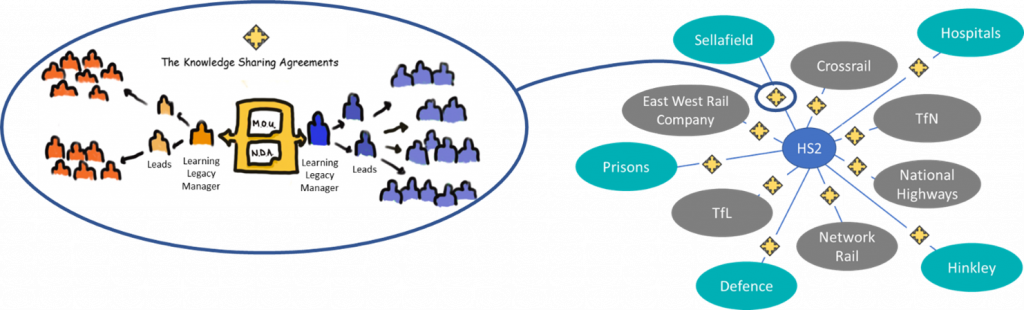
The knowledge sharing agreement is based on:
- A single point of contact (eg, Learning Legacy Manager) in each project for receiving and coordinating requests for learning
- Leads in the organisation (usually a department head) responsible for coordinating knowledge sharing in their functional area, assessing any impact in terms of resource or security and signposting to the right person in their teams or the supply chain
- Subject matter experts (SME)within the organisation willing to share their knowledge
- Requests for Learning form describing the knowledge required, key questions, document requests, and access to SMEs

On the Houses of Parliament Restoration and Renewal project, we found that Requests for Learning were key to guiding requestors to think about what they actually wanted, rather than making high level generic requests which turn out to be less helpful than they could have been.
This approach enables knowledge to flow between projects in a secure manner. The above approach was HS2 centric seeking to set up Knowledge Sharing Agreements between HS2 and other projects and is still in progress. Other projects should follow their lead and identify what projects/project organisations they could learn from and share learning with throughout their project lifecycle. Projects should then set up the Agreements early on and communicate them widely within the teams so that knowledge can start flowing through the mycelium network.
This is all the art of the possible. We are working with the Association to develop a white label version of the Knowledge Sharing Agreement so that we can get the mechanisms in place to nurture the mycelium network and enable the knowledge pathways across the industry, ultimately to improve project success.
About the author
 Karen Elson is a major projects consultant, chartered engineer and certified knowledge manager with 25+ year’s experience of major projects in the construction and transport industries. She provides expertise in learning legacy and knowledge management, continuous learning, process development, governance, assurance and performance monitoring and reporting of major projects for a range of clients including HS2, Palace of Westminster, Crossrail, Major Projects Association, the Olympic Delivery Authority and London Legacy Development Corporation.
Karen led the implementation of innovative and award winning learning legacy programmes across the construction industry including the Olympics, Crossrail, our own Major Projects Knowledge Repository and more recently continuous learning on the Palace of Westminster Refurbishment and Renovation programme and the HS2 Learning Legacy. Karen runs her own management consultancy business with 2 business partners and a select group of associates delivering improvements in major projects through focus on Knowledge, Networks and Behaviours.
Connect with Karen via LinkedIn, or the Co-Cre8 website.