


Published
In the literature, collaborative leadership is defined as the delivery of results across the boundaries of different organisations working together. If you are not collaborating, what does that tell you about your project’s leadership and the people involved?
Professor Carl Gavin, Alliance Manchester Business School
During our recent seminar on Collaborative Leadership, Professor Carl Gavin of the Alliance Manchester Business School, introduced the Complex P3 Leadership Model. This is a model of distributed leadership linked to the concept of the incomplete leader. Echoing ideas discussed in the opening session of the seminar, this approach moves away from a traditional autocratic leadership and replaces it with a model in which collaboration is facilitated by enabling leadership to be exercised by different actors across the project. Researchers have identified four key activities carried out by leaders who use this approach successfully, to which Carl’s team have added the personal quality of acumen to capture the importance of experience and judgement.
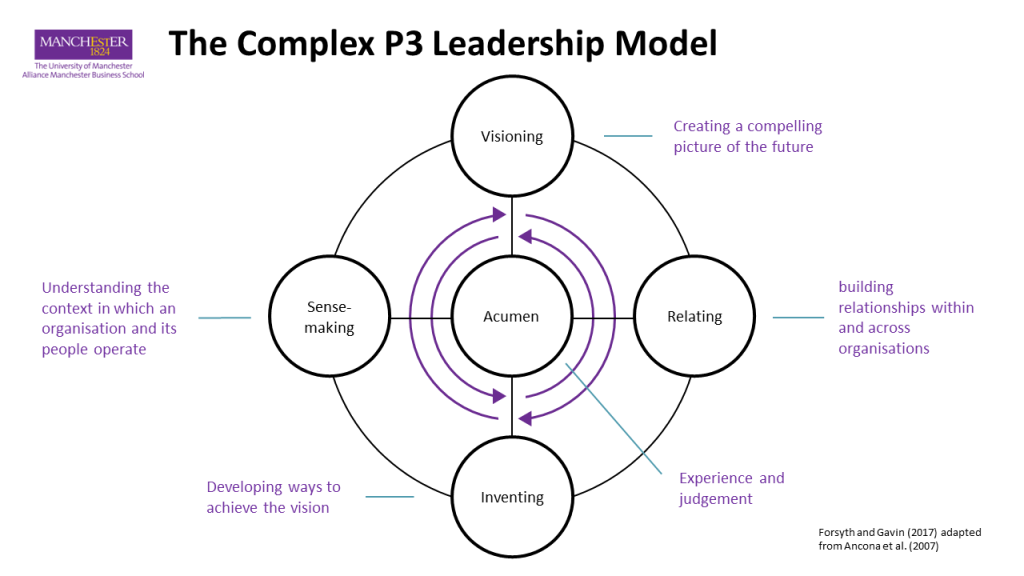
Carl used the model to interpret a series of videos from senior Association members capturing their thoughts on leadership. These were broadly reflective of the Complex P3 Leadership Model and while less was said about sense-making than the other topics, its importance was implied by the emphasis on working hard to develop collaboration across organisations, which is a vital precursor to generating the information leaders need to make better decisions.
Dr Simon Addyman of UCL, took a more provocative line, suggesting that taking the construction sector as an example, the major projects community doesn’t appear to understand collaborative leadership in the fullest sense. If the task of collaborative leadership is to reproduce effective organisational routines, the data suggests that the routines currently being reproduced in the sector are delivering flatlining productivity and a high suicide rate in men. He suggested a way forward may be to think about how collaborative leadership can focus more on the lived experience of the people working on projects and use that as the basis for redesigning the things such as procurement or the operating models that we use to reproduce routines.
More on collaboration
The Complex P3M Leadership Model was just one of the outputs from the Associations seminar: Collaborative Leadership – Lessons from the 2022 Games and Beyond. The Highlights Report from the event captures insights from across the whole seminar and is open to all. Association members may also view the speaker slides which cover the presentations from Carl and Simon as well as case study presentations from the Children’s Society (Mission for this Decade) and the 2022 Commonwealth Games (Creating a Team Culture and Purpose Across Diverse Stakeholders).
References:
Ancona, D., Malone, T. W., Orlikowski, W. J. And Senge, P M. (2007) In Praise of the Incomplete Leader. Harvard Business Review. 85(2), pp. 92-100.
Forsyth, S. and Gavin, C.J. (2017) ‘Developing “third wave” project leaders’, Project, Autumn.
Merrow, E.W. and Nandurdikar, N. (2018) Leading Complex Projects: A Data – Driven Approach to Mastering the Human Side of Project Management. Oxford: Wiley.
Further links
Harvard Business Review: In Praise of the Incomplete Leader
Forbes: Six Crucial Behaviors of Collaborative Leaders
Behavioural Science Behind NEC: Spotlight Podcast with Dr Emma Langman of BakerFish
Resources on the theme of collaboration in the Major Projects Knowledge Repository