


Published
The fifth in a series of guest blogs provided by Bentley Systems. In the first post, Mark Coates and his co-author look at how Singapore has embraced the concept of the digital twin, the renaissance of light rail, the idea of a national framework for data, and most recently, future proofing the water supply infrastructure. In this latest post Mark and Joe Rice-Jones, take a look at how the Dutch have approached electric vehicle charging in a typically imaginative, systems-thinking way.
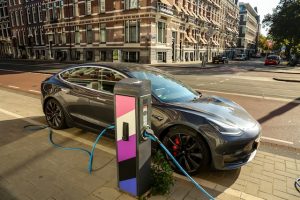 When it comes to the mass adoption of electric vehicles (EVs) in the United Kingdom., there are a range of barriers, from naysayers and believers alike. One of the most common is the lack of charging infrastructure, bringing inconvenience, waiting times, and increasing people’s fear of range anxiety.
Elsewhere, however, countries have proven that a large-scale installation, and adoption, of EVs is not only possible, it is also popular.
For example, the Netherlands has the highest number of public chargers installed per capita and per square kilometre, and despite having a population that is a quarter of the size of the U.K., it has installed almost triple the number of EV charging points. According to data from the European Automobile Manufacturers’ Association (ACEA), as of July 2022, the Netherlands had installed 90,284 chargers, far ahead of Germany with 59,410, France with 37,128, and the U.K. with 34,637.
This increase in chargers has led to a virtuous cycle in the high take-up of EVs, which reached 34% of all new car sales in Holland in June 2022. By contrast, the take-up of battery EVs and plug-in hybrid vehicles (PHEVs) in the U.K. has hovered at around 20% of market share during 2022.
However, the car market is growing quickly, with over 590,000 pure-electric cars on U.K. roads at the end of October 2022, and more than 1,000,000 plug-in models, if including PHEVs.
While the number of electric and hybrid vehicles in the U.K. has almost quadrupled from 264,486 in 2019 to 1,062,815 by the end of November 2022, the number of public charging points has only doubled from 16,971 to 36,752 within the same time frame.
In terms of communication, usability, and technology around their charging points, the Dutch approach has become the gold standard for EV rollouts across the world. 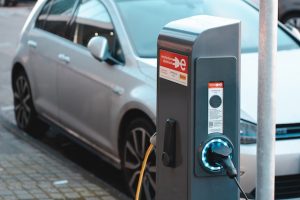
So, how do they do it?
Rather than creating barriers and conflicts between different organisations—and technologies—to bring more charging points to their country, the ELaadNL foundation in the Netherlands created the Open Charge Point Protocol (OCPP) in 2013. It handles the charging transaction and exchanges information between the vehicle and the grid.
Hosted by a Dutch foundation, the Open Charge Alliance—an international partnership of over 180 companies from more than 25 countries and based in Arnhem—ensures that EV charging systems are completely interoperable, speaking the same language through consistent rules and guidelines for data communications. This type of open communication and transparency is a theme that runs through the various aspects of the Dutch approach to EVs.
While there has been a government drive for greater e-mobility, rather than adopting a top-down, enforced method, the Netherlands use local mobility programs and area-wide tenders to bring electric charging to places where people want them.
For consumers, there are financial incentives to purchase EVs. New EV buyers can claim up to EUR 4,000 back from the government and up to EUR 2,000 for second-hand cars. There are also waivers on registration taxes and ownership taxes.
The Dutch also reduce the risk for private sector charging point operators by ensuring all installations are backed by proven demand. In the Netherlands, the owner of an electric car can request a new charging point for their area. The charging operator validates this request by investigating how frequently existing charging points are used nearby. An ideal location for an additional charging point can then be chosen based on the existing infrastructure, local use, and accessibility. From a consumer perspective, finding your nearest charging point is made simple through maps accessed online.
This system has enabled key cities such as Amsterdam, Rotterdam, and the Hague to encourage residents to request the free installation of charging points where charging at home or at work is not feasible. Reducing barriers to adoption is considered particularly pertinent for the country’s capital Amsterdam, which is aiming to be entirely traffic emissions free by 2030.
Other Dutch cities also get their residents involved with the electricity generation needed to charge the vehicles. Under a nationwide Green City Deal, 5,000 homes use solar panels to generate electricity for 200 EVs, which are then used as part of cost-effective car share schemes.
Even for larger EVs, such as buses, the Netherlands is ambitious in its goals. Not only are there plans for all buses to be emissions free by 2030, but also, from 2025, all new buses will be emissions free from the outset. In particular, the Dutch government has pushed for solar and wind energy generation to be used to power these vehicles.
A key driver behind the Netherlands’ roll-out of electric charging is joint working and collaboration across government, universities, and businesses, which understand that the thinking behind any nationwide campaign needs to be cohesive, and the experience appealing to the end user.
 The National Charging Infrastructure Knowledge Platform Foundation was created with the aim of lowering the cost of the infrastructure for all through sharing projects, particularly by optimising the installation process through conversations between the distribution system operator, the charging point operator, and the municipality.
When it comes to EV charging, “going Dutch” means that nations have to follow the approach of the Netherlands by being open, transparent and interoperable. Though the scale of the challenge is by no means insignificant, the pace of delivery across the Netherlands in such a short period of time means that many continue to look to the Dutch for tips on how to normalise, and expand, the role of EVs across society.
About the Authors
Mark Coates is International Director of Public Policy and Advocacy at Bentley Systems and a Strategic Board Member for the Digital Twin Hub.
Joe Rice-Jones is Strategic Account Director, Enterprise, Northern Europe, Bentley Systems.