


Published
This blog is a personal reflection of six and a half years of working at the Major Projects Association. The conclusions are all my own but the work and the developments I describe and from which I have drawn my insight were delivered by the Major Projects Association team: Andy Murray, Manon Bradley, Ruth Francis, Eleanor Mortimer, Sascha Flint, Ashleigh Walsh, Charlotte Bamford, Alli Spyer and our collaborator at a distance, Suzy Firkin, (plus me).
Ed Hoffman, ex Chief Knowledge Officer at NASA (and author of the brilliant book: The Smart Mission) first planted the idea of the ‘sound of success’ in my mind. What Ed was describing was the hum of conversations that he looked for when he walked into the NASA offices: people asking questions of one another, sharing information on what they were doing, solving problems together. (You can listen to Ed’s interview here).
At the recent Crossrail Learning Legacy day, Mark Wild described what’s it like when that sound becomes muted and altered. Mark explained how, as the launch deadline approached, the project team became increasingly stressed by the emerging evidence that they were way behind schedule. People stopped communicating or, when they did communicate they used impersonal reports or e-mails which conveyed little of substance. The whole project became increasingly opaque.
In the beginning
Sound and specifically, language and communication, have been amongst the main ways I (as a linguist) have navigated my six years at the Association. When I joined in 2017 to launch the Major Projects Knowledge Hub, our experience was very much that of Ed Hoffman. We met members in their offices or facilitated conversations with them face-to-face via the medium of our, in-person, seminar programme. The importance of the events as a medium for putting people together so that they could both listen to the experience of their peers and talk to one another was the basis on which the Association was founded and in the forty years since, this has never lost its significance.
Ed Hoffman’s interview was the first Masterclass I recorded for the Association. It kicked off our YouTube channel and opened a new audio (and visual) channel for members to acquire and share insight.
Social media
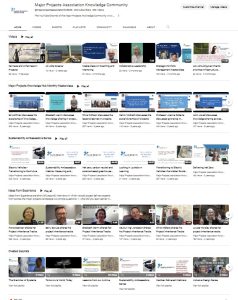 The Association already had a Twitter account and a Linkedin Group but our posts were notable by their absence. The launch of the YouTube channel and the Major Projects Knowledge Hub, originally as a freestanding website independent of the main Association website, both open to members but also the wider major projects community, created the need for regular communication via social media.
We started to create posts to engage people in what we were doing and the ideas we were collating and as a form of sense-making; helping them to understand the meaning and the significance of what was being shared. And, in turn, encouraging them to respond to, comment on and further share what they were finding.
Today our LinkedIn site has nearly 11,000 followers and the requirement to make noise around our activities is unchanged. If anything in the increasingly competitive airways, it is increased.
Along came lockdown
The 2020 COVID lockdown proved an immense disruptor to the rhythm of the Association. As with many other organisations, we had barely dipped our toe into the water to experiment with video streaming. The partnership with Bentley Systems, who made their Academy available for us as a venue for events that could be both in person and broadcast at the same time, had given us a taste for hybrid or virtual events, but we had no capability or technical experience of doing this for ourselves.
Our series of six Lessons from Lockdown webinars, launched in the Spring of 2020 and run in collaboration with the APM, gave us a voice when physical events were impossible and allowed us to anticipate what would later become the Fringe (the Association’s virtual events programme).
Through the summer and Autumn of 2020, we experimented with subject matter (including webinars on topics as diverse as Modern Slavery and the Principles of Project Delivery – Post Covid). This latter event was the first of our series of occasional webinars run in conjunction with the Infrastructure and Projects Authority, which we have continued to develop. We also experimented with platforms. ON24, GoToWebinar, Pine each allowed us to try different forms of audience engagement and the programme certainly amplified the Association’s reach in terms of people, organisations and geography. This last point was particularly important since, as impactful as the in-person seminar programme has been, the need to come to London (or occasionally Birmingham or Manchester) has always been a barrier to the conversation for members in far flung locations.
The early events were essentially real-time broadcasts with limited opportunity for the delegates to add their voice to what was going on. We soon found there was nothing as lonely as listening in on a webinar alongside perhaps as many as 500 other delegates.
The Fringe
By the Autumn of 2020, our virtual programme had coalesced into something we called our ‘Fringe’ (in homage to the Edinburgh Festival Fringe). We delivered a programme of multiple virtual events at the time of our 2020 Annual Conference, which collectively addressed the issue of the lack of effective audience interaction and dialogue in webinars. In a series of bookclub sessions, workshops and round tables we experimented with a host of new tools: Zoom, virtual MIRO whiteboards, Mentimeter and the virtual, immersive, QUBE@Work to bring the sound of delegates chatting, sharing and laughing into the events.
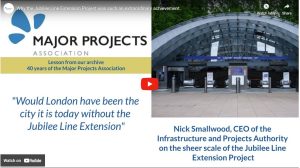 With the advent of the Association’s 40th anniversary, we introduced a new format to our media: Lessons from our Archive. This series provides the opportunity for members of the Association to pick up and review a report from our extraordinary archive going back over 40 years and covering, amongst other things, iconic projects such as Concorde, the Channel Tunnel, the Privatisation of Electricity Supply and many, many others. It’s intriguing and often enlightening to get a 21st Century perspective on projects from the past to understand how things have changed (and how they have stayed the same).
The Fringe continues in 2023. Our various 60 to 90 minute events serve to ‘riff’ on themes introduced at particular seminars, to introduce tools or techniques such as the IPAs Project Delivery Route Map, and experiment with other media, such as Opiner or now, the regular feature of our Podcasts. These are essentially conversations with and between some of the speakers and panellists at each of our main seminars, which can then be downloaded and streamed by anyone who wasn’t able to attend in person. The Programme Committee have also charged us, recently, to include events in the Fringe programme that we can effectively road test with a view to expanding and developing them into a half or full-day seminar in the subsequent event season.
The growth of the networks
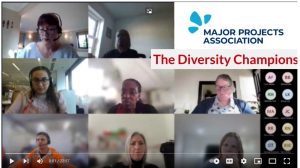 Soon after I joined, the Sustainability Ambassadors network began to introduce new voices into the Association; often younger members who were responsible for designing and delivering webinars and events of their own, with the Association acting simply as facilitator and host. These events and the networks that spawn them have grown, even during the Pandemic, partly because as Fringe events, they are virtual, so relatively easy to stage but also, I suspect, because those members who have become involved in this stream of conversations needed an outlet for their voices during lockdown.
More recently, networks such as the Project Sponsorship Network, those involved with the Inclusion Hub or the Early Careers Network, have broken the fourth wall and taken previously virtual events back to face-to-face; once again changing the sound of engagement and collaboration.
The Peer Mentoring programme
Our events programme has always primarily been about giving the stage to our members to share their experience. The network driven programme have meant that the sound of the Association team is even further in the background than in the seminar programme.
The launch of the Association’s peer mentoring programme, in 2022 created a new sound entirely; that of two individuals, connected through the Association, initiating a regular drumbeat of one-to-one conversations between themselves.
The Future
If the diversity of voices and the richness of the conversations has been driven, since 2017, by our adopting of virtual events and the tools associated with them, as well as the network events programme, in 2023 a new song has been added to the playbook; one that is very compelling, albeit we struggle to learn the actual words: Artificial Intelligence. The Association has anticipated this change, regularly sponsoring the Data Hackathon’s, whose noisy, in person, environments bring us back to Ed Hoffman’s ‘sound of success’.
I cannot begin to anticipate how this will change the nature and sound of the conversations that the Association enables. However, I suspect that Data Analytics and AI, far from muting the volume of human voices will increase it, as we ask one another: “What does this mean for our work and our projects?”, “What should we do next?” or “How do we need to organise, communicate and collaborate to take advantage of this fast-emerging future.”
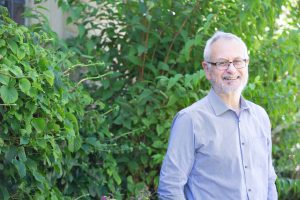 Jonathan Norman
This will be my final post for the Association, as I am going freelance from 1st June, as a prelude, in a couple of years’ time to retirement. I have thoroughly enjoyed being part of the buzz – the conversations, activities and events – that the Association does so well and I am extraordinarily grateful to all those members with whom I have worked and who have helped me in my role as Knowledge Manager. If you would like to continue the conversation with me in the future, then I would be delighted if you would connect with me on LinkedIn or contact me at jsnfarnborough@gmail.com.