


Published
On Monday, the Government released its much-anticipated Strategic Defence Review. As expected, it includes details of investments in military capability and equipment such as submarines and munitions, but it also includes aspects of innovation, transformation, regional regeneration, and economic growth that will be of interest to members of the Major Projects Association. Here is a summary and some takeaways we found interesting.
The Strategic Defence Review 2025, or SDR2025, comes against a backdrop of geopolitical instability: ongoing security challenges, including tensions with Russia, cyber threats, and strategic competition with China. But it’s also shaped by rapid technological change, the increasing complexity of major projects, and the identified need to enhance the UK’s defence preparedness.
While primarily focused on defence, the document also outlines goals related to resilience, economic development, and collaboration across sectors. Here’s what stood out.
1. Defence spending and infrastructure opportunities
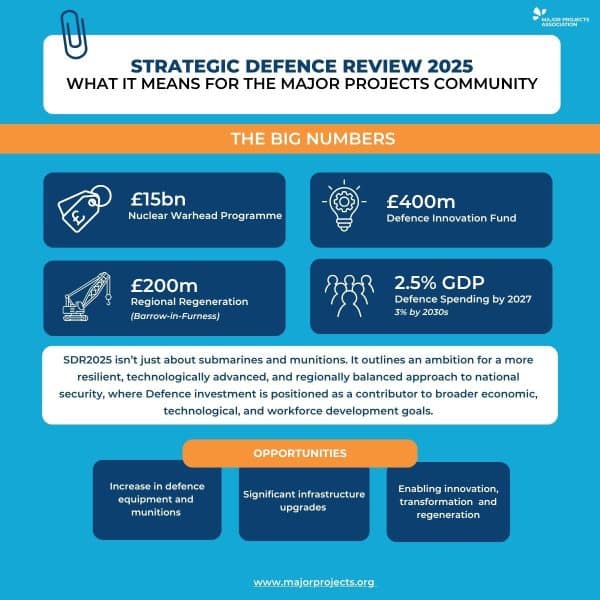
SDR2025 outlines a significant increase in defence investment, described as the most substantial since the end of the Cold War. Defence spending will rise to 2.5% of GDP by 2027 and 3% in the 2030s. This includes £15 billion for the sovereign nuclear warhead programme and substantial infrastructure upgrades.
For those in the major projects sector, the Defence Infrastructure Recapitalisation Plan promises significant opportunities. Expect upgrades to ports, airfields, military bases, and logistics hubs. In places like Barrow-in-Furness, £200 million of regional regeneration is planned. These projects will demand the kind of complex, multi-stakeholder expertise that many members of the Major Projects Association provide, blending physical infrastructure with digital innovation and community engagement.
2. Procurement reform: a new way of working
Perhaps the most striking element of SDR2025 for major projects is the comprehensive reform of defence procurement processes. Previously challenged by delays, complexity, and cost management issues, the Defence sector is set to adopt more agile and collaborative approaches.
The existing Equipment Plan will be replaced by a Defence Investment Plan, shifting focus from monolithic, decades-long programmes to more modular, adaptive delivery. Procurement cycles will be shortened dramatically – from years to months – by segmenting projects into manageable components and employing spiral development, where capabilities are delivered in iterative stages.
A new Defence Innovation Fund (£400 million) will support R&D, while the establishment of a Defence Investors Advisory Group will engage private finance and support the development of high-tech and dual-use companies. Defence aims to broaden its supplier base, seeking partnerships with innovative firms in AI, robotics, and digital infrastructure.
For Major Projects Association members, this signals a shift towards delivery partner models, outcome-based contracting, and whole-life asset management – approaches we’re already seeing in major infrastructure programmes. The parallels with recent trends in the civil sector are clear. Our upcoming seminar on The Rise of the Delivery Partner provides an excellent opportunity to explore how these evolving procurement models can drive efficiency, innovation, and resilience across both public and private sectors.
3. Regional growth and skills development
SDR2025 recognises that defence investment can be a catalyst for regional growth. It includes plans to expand Cadet Forces, increase Active Reserves by 20%, and enhance engagement with schools and colleges. The goal is a more skilled, agile, and diverse workforce that can support both Defence and adjacent sectors.
For regions hosting major defence and infrastructure projects, this investment in people and place mirrors lessons from major civil projects: skills pipelines, community engagement, and inclusive growth are just as critical as physical assets.
4. Innovation and digital transformation
SDR2025 sets out a vision for a digitally-enabled, AI-driven military force. The Digital Targeting Web concept will connect sensors, decision-makers, and effectors at machine speed, underpinned by investments in R&D, cyber resilience, and digital infrastructure.
For Association members, this emphasis on data-driven decision-making, modular design, and digital twins resonates with the digital transformation underway in sectors like transport and energy. There’s much to learn – and contribute – through cross-sector collaboration.
5. Partnerships, collaboration, and exports
Finally, SDR2025 highlights a shift towards more collaborative partnerships, both internationally and domestically. There’s a focus on engaging NATO allies, forming new alliances (such as AUKUS and the Global Combat Air Programme), and boosting UK defence exports.
For the major projects community, this reflects a broader trend: blurring the lines between Defence and civil sectors, fostering public-private partnerships, and creating new opportunities for innovation and growth.
In summary
SDR2025 isn’t just about submarines and munitions. It outlines an ambition for a more resilient, technologically advanced, and regionally balanced approach to national security, where Defence investment is positioned as a contributor to broader economic, technological, and workforce development goals – themes that will be familiar to those outside the defence sector.
There is plenty for members to consider in SDR2025 and we’ll make sure we delve into and learn more about defence projects in our events programme, studies and networks as a result.
Read the Strategic Defence Review 2025 here.