


Published
We started the Major Projects Association YouTube channel in September 2017 and the collection has grown to over 250 videos: short and long interviews, recordings of streamed events, themed series and much more. The lifetime statistics are encouraging, for what is essentially quite arcane content: over 27,000 views and 1,400 watched hours. This month we’ve done particularly well with approaching 1,000 video views.
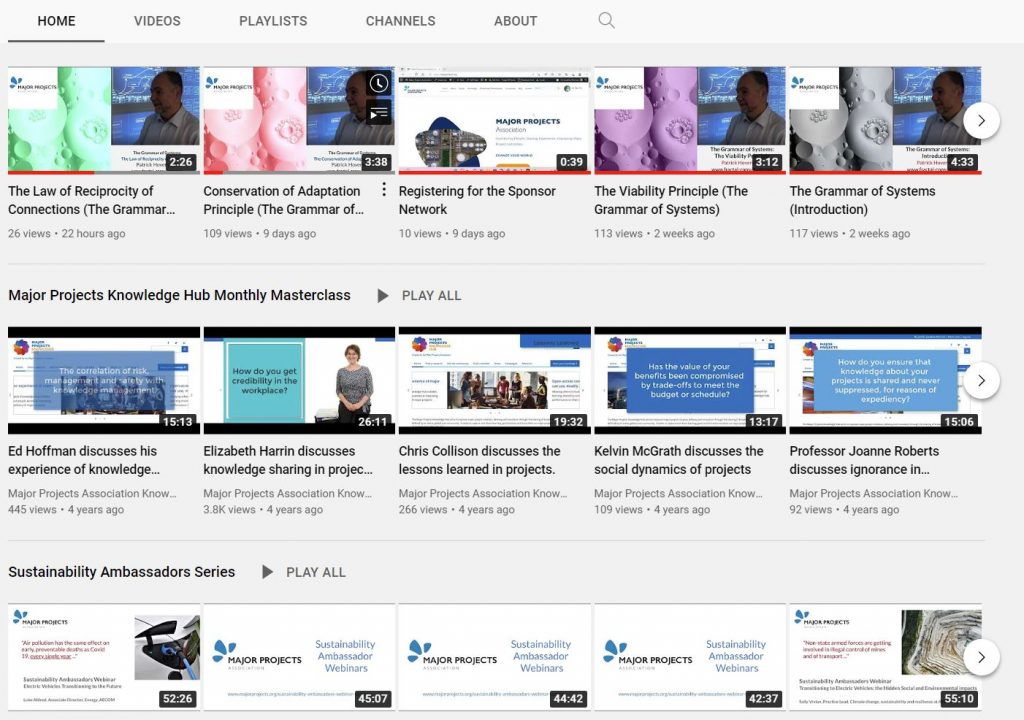
Why have we taken to video so wholeheartedly and why might you make more use of video for internal knowledge sharing?
- Because we can
Before we started in 2017, we had never recorded, edited or posted a video. One of the huge benefits of the smartphone revolution is is that they have become both a personal video player and a high quality video camera. If you doubt the quality of what you can shoot on your phone then try this experiment. Record yourself talking to screen on your smartphone. Now do the same using the webcam on your laptop. Compare the footage from the two and you’ll see just how good phone cameras are now.We use a cheap and very intuitive software called Movavi to edit and process the videos. Using a laptop and the software we can do everything we need to: edit the footage, splice together different videos; add music or audio, captions or subtitles. - It allows spontaneous, as well as planned knowledge capture
Sometimes we’ll want to plan a recording; particularly a longer interview for example. But at other times, it’s great just to point a camera or a mobile phone at someone (or with their permission gather some footage from a Teams or Zoom call) and capture some insight spontaneously. Try it yourself, next time someone shares something particularly pithy in a lessons learned session, a risk workshop or any kind of meeting, stop and ask them to repeat what they’ve just said while you capture it on your mobile phone. - Video is a brilliant medium for capturing tacit knowledge
The kind of thing that is very hard to capture and transfer in a report or even a written blog post. We can observe body-language (enthusiasm, doubt, excitement, frustration) in the gestures and the tone of voice in recordings. Video is a wonderful medium for sharing humour, emotion and personal values; all of the human elements that influence our behaviour and our beliefs. - If you’re looking for cognitive diversity, look no further
Try asking 10 people in the business the same question and recording their answers. A simple as ‘what does success look like to you for project XYZ’ will elicit a wonderfully rich collection of responses, particularly if you ask the question of some of your contracting partners and some of the end-users too. We often strive for a ‘single source of truth’ on projects, which is extraordinarily useful if you are considering hard facts about what is and isn’t in scope or how much concrete can be laid in a day but is absolutely useless if you are trying to gauge stakeholder appetite for risk. - There is no better medium for storytelling
Witness our (almost universal) appetite for great cinema or small screen entertainment. You may not be creating something for the Avengers Universe or Downton Abbey (and probably not best to aspire for that when you first get started) nevertheless, you can use video very powerfully to tell a story; to track and communicate progress on a construction site or even to drip-feed the constituent elements of an idea, one element at a time each week, which what we are doing with our latest series on the Grammar of Systems.
It maybe a truism that a picture is worth a thousand words but that doesn’t make it any less powerful and once you translate the still image into a moving picture with sound, then the impact is increased one-hundred fold.
Don’t get me wrong, there are all sorts of situations and data on projects for which video is absolutely the wrong medium. And, just as with other media, you can do video well or you can do it very poorly. The message I want to convey in this blog is that you no longer need a professional film crew and a Hollywood director to use a medium that can engage, educate, inform and develop people on your project.