


Published
 At the start of every year the Association surveys all of our members to invite suggestions for issues, topics, challenges or developments that we should use as a basis for designing and selecting the forward seminar programme. There is a very important principle that defines how we plan the programme, which is that we are entirely driven by what our members ask for. The first part of this process involves soliciting ideas and then our programme committee, essentially volunteers drawn from the membership, interpret, combine and prioritise the submissions into full and half-day seminars, breakfast discussions, evening meetings, site visits or one of the other rich mix of activity types we use.
Since 2020, we’ve also run a series of fringe events alongside the main programme; essentially virtual events of different kinds, but the fringe programme is also member-driven. Fringe events are either designed by one of our members networks, for example the sustainability network or the sponsorship network, or are echoes of the events that we are running in the main events programme; designed to enable us to extend the knowledge sharing beyond those who could attend physically or, sometimes, to the wider major projects community.
The results do have a level of predictability and consistency to them. Major projects rarely lend themselves to definitive answers to any given question or solutions to any given challenge and so it makes sense to revisit key themes on a regular basis to explore new developments or offer fresh perspectives. A quick review of the themes proposed by members in recent years provided me with the following breakdown: Climate Change and Sustainability (3); Contracts and Procurement (11), Cost (2), Data and Technology (11), Finance and Business Case (2), Health and Wellbeing (4), Innovation (3), Knowledge Management (6), Leadership (2), Next Generation (6), Politics (3), Productivity (1), Programme Management (5), Risks and Controls (5), Stakeholders (5), Transitions and Change (3).
What is the best way to frame a request for an event?
This is where the naked self-interest comes in. Whilst it may be tempting to suggest ideas for themes that you think ‘might be good for the industry’, many of the best topic ideas are driven by more immediate experience or need: what did you do in the last 12 months that was particularly difficult and painful? (Which lends itself, either to a request for learning to make the experience for less challenging next time you encounter it, or for an opportunity to share what you learned); what are you going to need to do in the next 12 months that you’ve never done before? (Which is an opportunity to ask for experience from other members who have mastered this process). Of course, this is major projects so you may be experiencing some increasingly chronic issues, those things that seem to trip you up repeatedly across different projects: what are your recurring (or growing?) issues, challenges, obstacles?
If you need a little help here are a couple of ideas to spark your thinking:
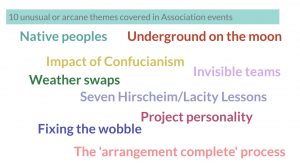
I have chosen 10 items that seemed particularly arcane and unusual from the contents list of the 250 or so reports from the Association’s archive, which stretches back to 1981.
or you might consider using the Seven ‘Images of Projects’ (from Mark Winter and Tony Szczepanek’s book of the same name, which they wrote in response to the Rethinking Project Management research programme of 2002-2007), to help you identify and frame a request for an event:
Image 1: Projects as social processes – the ever changing flux of events, the individuals, groups and organisations involved, and other aspects such as social networks, culture and tribalism, and language and metaphor
Image 2: Projects as political processes – the differing interests of the individuals, groups and organisations involved, hidden agenda, power and influence, political tactics and people’s attitudes to politics
Image 3: Projects as intervention processes – the perceived situation to be improved, the type of intervention and the different phases of intervention from an initial review phase through to an evaluation phase
Image 4: Projects as value creation processes – the desired value and benefit, core purpose, outcomes, and outputs, and the different phases of value creation from the strategic phase through to the value realisation phase
Image 5: Projects as development processes – the type of development (for example, infrastructure development), the core development concept, and the different phases of development activity
Image 6: Projects as temporary organisations – the executive (for example, roles and responsibilities), support activity (for example, training), communications and marketing, operations
Image 7: Projects as change processes – the context and rationale for the change, the perceived scope and content, and the different phases of the planned change from the ‘upstream’ phase through to the ‘downstream’ phase
Submit your ideas/requests for events
Anyone who works for an Association member organisation may submit an idea or request for an event at any time. We capture your feedback throughout the year. Simply e-mail your thoughts to the Association or ring us, if you prefer. Eleanor Mortimer, our events manager will look at your request, ask for any further information if it’s not immediately clear what you are proposing and then share it with the programme committee. They, in turn, will review it, to decide whether it is something that will engage the wider membership and if so, what kind of event would it best suit (e.g. half-day, full-day, discussion breakfast, and so on).
Jonathan Norman, Knowledge Manager