


Published
When the Crossrail was in full swing, for a time it was the biggest infrastructure project in Europe. These days it wouldn’t even register in a top 10 of infrastructure megaprojects currently underway around the world.
 This is significant for a number of reasons: it clearly signals the trajectory of our aspiration and ambition (this despite the notorious performance record of mega-, and now giga-projects). It also underlines the challenge in terms of how you can find the best people to deliver these highly complex endeavours when you are competing with for every Tom, Dick and Harriet with projects that are likely to be bigger, better and generally sexier than yours.
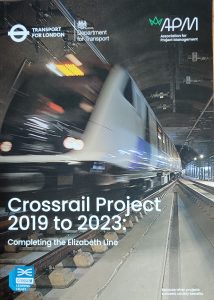
Despite the well-documented melt-down on Crossrail and the subsequent recovery programme, there is one aspect of major infrastructure delivery that Crossrail championed from the start and which is so significant for our future capabilities and ambitions: the Crossrail Learning Legacy.
Learning Legacies have a very specific purpose. They are difficult and expensive to build and they require continual activity during and long after the project, on which they are based, is concluded.
The main platform for learning transfer in our pipeline of major projects are the people who deliver them. People who learn valuable lessons through their experience which they then take with them to their next organization or large project, rather as a hive of bees disseminates its DNA through the queen bees that lead the swarm to set up colonies elsewhere. This is, and always will be the prime vehicle for transferring ‘know-how’, the tacit knowledge that is so difficult to capture and collate outside of social interactions and activity.
But every major project leaves a rich legacy of explicit knowledge: engineering or project techniques, processes, documents and templates which can and should be shared from one project and the next and which, unlike tacit knowledge, are difficult to share simply through social learning.
Learning Legacy is a time-consuming and difficult process
Translating these into a Learning Legacy is a time-consuming and difficult process. For one thing, it is important that the knowledge you are sharing is correct, which means that the material in any learning legacy needs to go through the process of peer review. For another, it needs to make sense to someone outside of the project or the specific organisation which is generating the legacy. All knowledge is contextual and if you are looking for ideas to be shared across organisational or even sector boundaries, you need to make sure that the lesson comes with enough context, the back story, that will enable those seeking to learn to take the ideas and translate them into the context in which they are working. So designing, crafting and communicating these lessons is as much an art in storytelling as it is a lesson in maths, physics or engineering.
Their value, as with the infrastructure projects on which they draw grows and develops over time
That Crossrail committed so strongly to deliver a learning legacy is no surprise. This was the first infrastructure project of its kind to be values driven and learning legacy represents a firm commitment to the future of the project and engineering professions.
It may also explain why they understood the value to people within the project who contributed towards the legacy – helping them to realise their own ‘self-actualisation’ (to use language of Maslow). Mark Wild, the Chief Executive of Crossrail during the final delivery phases of the Elizabeth Line talks very passionately about the need for major projects to have a live sense of mission, a shared ‘purposeful whole’, and learning legacy is a very tangible reflection of this. Contributing to a Learning Legacy allows your knowledge and achievements to be recognised, gives you a presence alongside your peers, and imbues you with the satisfaction that what you are learning will be passed on to the next generation of projects and the people that run them.
No single medium for learning from projects is perfect, far from it, but (not least because of the scale of these projects) every single lesson learned and applied from one project to the next represents a substantial cost-saving, risk mitigation or value add (and often all three).
Learning Legacy and the future
The future of Learning Legacy will depend on the willingness of other mega-projects to invest the time and effort needed to learn from the current legacies and then create legacies of their own, ideally capturing learning from the earliest days in the project.
Unfortunately, whilst the mantra ‘build them and they will come’ may hold true of (some) big railways and other large infrastructure, it most certainly isn’t true of learning legacies. Because, whilst explicit knowledge (the ‘know what’) may most effectively be curated, collated and explained through the media associated with learning legacies, the dissemination, adoption and further development of this knowledge is just as much a social activity as is the sharing of tacit or implicit knowledge. That means we need to create the opportunities, the conversations, the events and activities into which we draw elements of the knowledge from Learning Legacies, if we are to realise their value by learning and adapting our existing working practices, as well as generating the next level learning that will enable us to conquer the uncertainty, constraints and challenges of the even bigger, more complex, and more aspirational projects of tomorrow.
 The latest lessons from the Crossrail Learning legacy that capture the period from 2019 to the launch of the Elizabeth line and beyond are now available on the Learning Legacy Site.
 Everyone can access the lessons not just from Crossrail but from the other Learning Legacies (London 2012, Thameslink and now HS2) via the Major Projects Knowledge Repository, which brings them all together.