


Published
Today, Chancellor Rachel Reeves MP presented the Budget to parliament. Our Executive Director, Andy Murray, was on hand to listen to her speech and has pulled out some key points for our members. Here are his highlights.
It was a long speech! Nearly an hour and a quarter. And most of the content relating to major projects came relatively early with a few major projects such as Sizewell C, Lower Thames Crossing and the Small Modular Reactors being name-checked. The Chancellor explained that medium-term capital envelope looks stable rather than squeezed with departmental capital budgets being protected with public sector net investment at 2.7% of GDP. Big programmes already in the pipeline are less likely to face sudden funding stop-starts.
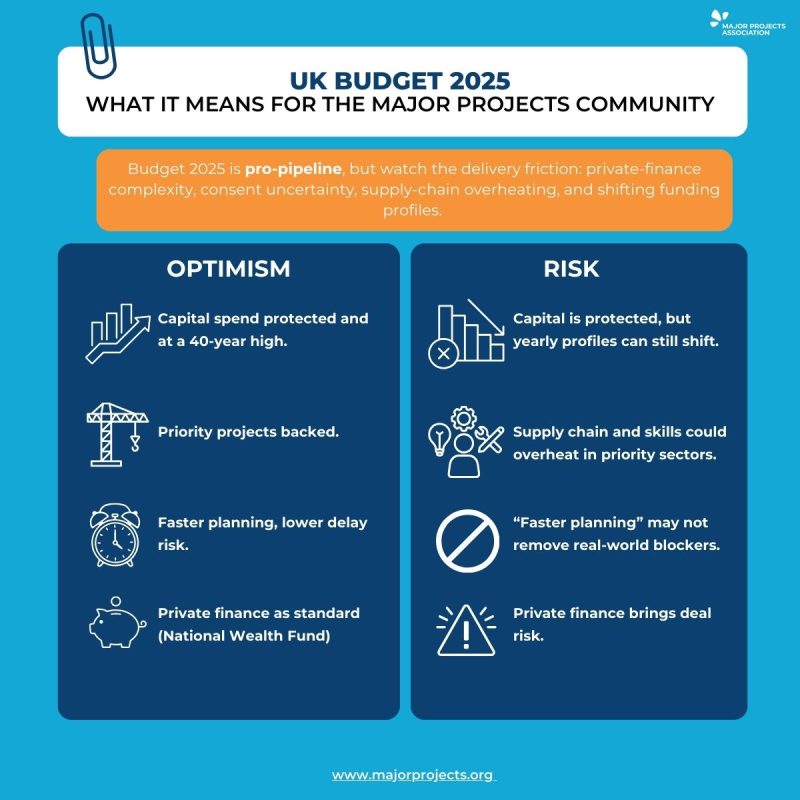
The Chancellor emphasised the importance of streamlining planning and also name-checked the recent Fingleton report into nuclear regulation. It is clear the Government is explicitly trying to reduce one of the biggest causes of major-project overruns: slow consenting. For project owners and Tier 1s, that should improve investor confidence, earlier start dates, and lower financing costs, but it also means greater pressure to come to consent “ready to go” (better front-end definition, faster mobilisation).
The trend for more devolution continued with the Chancellor confirming commitments to regional transport projects overseen by Mayoral bodies and the ability to fund additional schemes through rate retention. There were also references to regeneration schemes in places hosting major projects such as Barrow and Derby.
Expect departments to keep pushing major-project business cases that align with growth and decarbonisation. Priorities continue to cluster around strategic transport, nuclear/energy, and place-based growth corridors.
A look at the budget document in more detail…
1) Departmental capital investment headroom is being protected (good for pipelines)
The Budget re-states that the government has committed over £120bn of additional departmental capital spending across the Parliament, and that this investment is being “protected” for growth priorities like transport connectivity and nuclear.
It also says public sector net investment will average around 2.7% of GDP, described as the highest sustained level in four decades.
2) Big, named project commitments signal priority areas
The Budget highlights or re-confirms several flagship commitments:
- Sizewell C: the Spending Review commitment of £14bn is reiterated, and the Budget notes a reclassification treatment for Sizewell C (as Mega Projects capital AME), signalling central focus on nuclear delivery.
- Lower Thames Crossing: a further £891m is committed as the final tranche of public works to enable a privately financed construction/operation phase, with a Regulated Asset Base (RAB) financing direction and market engagement from 2026.
- Northern and city-region transport: ongoing delivery of the £11bn Transpennine Route Upgrade and a further £15.6bn through the Transport for City Regions Fund/CRSTS to support metro, tram, bus and station schemes.
3) Planning and consenting reform is meant to cut schedule risk
A major delivery lever in the Budget is the Planning and Infrastructure Bill (PIB). It claims:
- streamlining NSIPs and judicial review changes could reduce delays by up to 6 months,
- more targeted pre-application engagement could shorten major infrastructure delivery timelines by up to 12 months,
- a target to fast-track 150 major infrastructure planning decisions by Parliament end.
4) Expect more blended and private finance
The Budget doubles down on using private capital:
- It builds on the 10-Year Infrastructure Strategy to expand private finance use, including new PPP models for some programmes (e.g. NHS Neighbourhood Health Centres), developed by the National Infrastructure and Service Transformation Authority.
- It repeats that some megaprojects will be entirely privately financed, such as Heathrow expansion.
- The National Wealth Fund (NWF) is framed as a catalyst to mobilise £70bn of private investment, with £27.8bn public capital available and a growing portfolio across energy, transport, advanced manufacturing and digital.
5) Place-based acceleration + Green Book tweaks affect where projects win
The Budget references reforms putting “place” at the centre, including Green Book changes and early “place-based business case” adopters, plus a new Regional Project Accelerator under the National Wealth Fund.
For the full Budget document, visit the Government’s official publication page.