Published
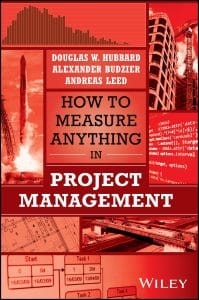
Projects shape our world, but too often, they fail in predictable ways. In their new book How to Measure Anything in Project Management, authors Douglas W. Hubbard, Dr Alexander Budzier, and Andreas Bang Leed argue that better measurement is the key to better outcomes. Ahead of their ‘Meet the authors’ webinar on Monday 17th November 2025, the authors share why the project profession must move beyond intuition and dashboards to embrace evidence-based decision-making.
 Projects fail too often, and they fail in predictable ways.
Across decades, sectors, and continents, cost and schedule overruns remain stubbornly constant. Methodologies, certifications, and software have multiplied, yet results have barely changed.
The profession’s response has been to design new frameworks and dashboards, but rarely to ask the simplest question of all: Do they work?
Our new book, How to Measure Anything in Project Management, begins with a simple but radical claim.
Anything that matters in projects is measurable.
If it matters and is not measured, it will be mismanaged.
The iron law of project management
When Oxford Global Projects analysed more than 20,000 projects worth over six trillion dollars, we confirmed what Bent Flyvbjerg once called the iron law: over budget, over time, over and over again.
Only 0.4 percent of projects in the dataset met their budget, schedule, and benefit targets at the same time. These are not random errors. They are systematic and repeatable.
Behind this persistence lies a common cause: misleading or meaningless measurement. We produce floods of data (dashboards, KPIs, traffic-light reports) but most of it is noise.
We measure what is easy, not what is important.
The measurement inversion
The most valuable measurements in projects are often the ones we never make.
Project managers often say, “We can’t measure stakeholder satisfaction,” or “innovation,” or “social value.” Yet these so-called intangibles often drive the real outcome of a project far more than the metrics we report each month.
Anything that affects a decision can be measured because measurement is not about counting; it is about reducing uncertainty. A good measurement does not need to eliminate uncertainty. It only needs to reduce it enough to improve a decision.
If you can observe something in any degree, directly or indirectly, you can measure it.
The analysis placebo
Project management, like medicine before it, suffers from its own placebo effect.
Many of our tools create the appearance of control: risk matrices, red-amber-green dashboards, uncalibrated estimates. They make us more confident in being wrong.
We call this the analysis placebo.
It feels analytical but fails the simplest test: does it reduce uncertainty about a consequential decision? If it does not, it is not measurement. It is theatre.
Evidence shows that calibrated expert judgment, Bayesian updating, reference-class forecasting, and Monte Carlo simulation outperform traditional scoring systems.
Small, well-designed measurements deliver far more insight than large, symbolic dashboards.
Your Meta Project
If the purpose of project management is to make better decisions under uncertainty, then the most valuable project is the project to improve how we manage projects.
We call this the Meta Project.
In every organisation we studied, investing even a small fraction of portfolio resources in better measurement produced the highest returns.
When a global firm applied these principles, the benefit of improved measurement outweighed its cost by a factor of twenty.
Improving how we make decisions improves every decision that follows.
A call to evidence
Our profession likes to describe itself as evidence-based, yet much of what passes for best practice has never been tested.
Standards proliferate without proof. Certifications reward compliance, not outcomes.
We need to apply the same scientific scepticism to project management that we demand in engineering and medicine.
When a method claims to reduce risk or improve accuracy, we must ask: Where is the evidence? How was it tested? What were the results?
Otherwise, we continue what Flyvbjerg once described as the “survival of the unfittest”, where the worst ideas persist because they are the most popular.
For those seeking current data and trends, APM’s research into the state of the profession provides further evidence of the growing complexity and need for measurable insight.
What project managers can do now
Measure what matters: Start with the decisions that define your project. Ask what information would truly change those decisions. Measure that and nothing else. Everything else is noise.
Replace ordinal scales with probabilities: If your option analysis uses one-to-five scores, you are guessing. If your project status is red, amber, or green, you are guessing. If your risk register ranks threats as high, medium, or low, you are still guessing.
These are not measurements. They are opinions with numbers attached. Replace them with data that mean something. Quantify likelihoods and impacts. Express uncertainty as probability, not colour. Projects deserve evidence, not intuition dressed as analysis.
Use reference classes: Avoid the uniqueness trap. Look backward before you plan forward. Compare your project to the hundreds or thousands that came before it. Learn from their errors and their outliers. Reality is your most reliable dataset. Calibrate your expectations against it, not against optimism.
Quantify uncertainty: Stop reporting single numbers. Report ranges, not points. State confidence, not conviction. A good forecast is not the one that sounds sure; it is the one that admits doubt and measures it.
Make measurement continuous: Treat every review as an experiment. Ask what you have learned since the last one. Ask how your uncertainty has changed. A project that does not update its measurements is not learning; it is guessing with greater confidence.
Better measurement is not bureaucracy. It is discipline. It is how projects grow wiser over time instead of merely older.
Why it matters
Projects are how societies build the future: infrastructure, climate solutions, digital transformation, healthcare. They consume enormous resources and define our collective progress. A world that spends more than forty trillion dollars each year on projects cannot afford guesswork disguised as management.
Better measurement is not a technical upgrade; it is a moral imperative. It means fewer failed hospitals, fewer stranded assets, fewer public scandals.
Better measurement means better stewardship of public money, private capital, and human effort.
The end of intangibles
Project management must evolve from a craft of intuition to a discipline of evidence. The message of How to Measure Anything in Project Management is simple: uncertainty is not an excuse for inaction; it is the reason for measurement.
If you want better projects, measure them.
If you want better decisions, measure what matters to those decisions.
Measurement is not bureaucracy; it is progress.
Without it, progress is an illusion.
Authors