Published
On Thursday the Chief Secretary to the Treasury, the Rt Hon Darren Jones MP, presented the 10-Year National Infrastructure Strategy to parliament. Our Executive Director, Andy Murray, was on hand to listen to his speech and subsequent questions from MPs and has then pawed through the 105 page document to pull out some highlights for our members. Here are his highlights.
In truth there were no real surprises in the National Infrastructure Strategy, as it builds on numerous announcements made in the Kings Speech last July (e.g. forming of NISTA and the National Planning & Infrastructure Bill), the Prime Minister’s Plan for Change in December (e.g. the priorities for the Government missions), the Chancellor’s Spring Statement in March (e.g. changes to fiscal rules regarding debt treatment of capital investments) and more recently the Strategic Defence Review e.g. (increase spending to 2.5% of GDP) and the Spending Review 2025 (e.g. commitment to numerous projects such as Sizewell C and Lower Thames Crossing).
The scale of investment and likely changes regarding how we select, finance/fund and deliver our infrastructure projects has been well trailed over the first year of the Labour government. We’ve also had a drip feed of specific projects getting the nod over the past month.
But there was a lot to glean when seeing it all brought together in a joined up way and with additional detail in a good number of places. There was a lot to like too, for example, the strategy reconfirms our 2050 Net Zero commitments and features prominently in two of the six themes of the strategy.
The strategy comprises six sections: reforming approaches, encouraging private investment, clean energy, investing in the regions, social infrastructure and improving the environment. The government missions, particularly growth, clean energy super power and housing are threaded through each section in so far as how they set the priorities or how the revised approaches to infrastructure will help them.
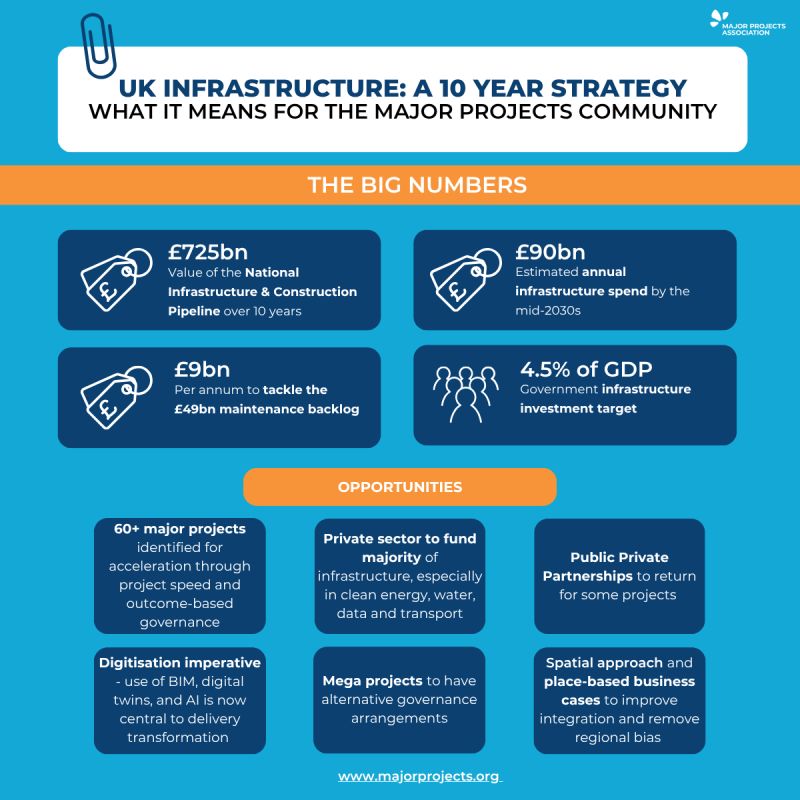
The scale of the investment will grab the headlines, with the 10-year strategy coming with a £725bn funding commitment from the government, with a five year commitment and a rolling two year update for “mega projects”, changes to how departments receive their capital allocations and more delivery through devolved administrations, particularly the Mayoral Authorities, through integrated settlements. The annual infrastructure spend by the mid-2030s is estimated to reach £90bn and the strategy goes further by including a target to increase spending to at least 4.5% of GDP annually. This is a significant increase. To give some context:
- Over the past 40 years the UK’s infrastructure investment has traditionally hovered between 2.5% to 3.0% of GDP and dropping as low as 1.5% post-2008 financial crisis and the austerity years.
- The 4.5% target marks the highest sustained UK infrastructure investment level in modern times
- The OECD average for infrastructure investment is around 3.5–4.0%, depending on measurement scope, putting the UK’s target investment above average for OECD economies.
And that’s just the exchequer funding. The strategy includes regulated infrastructure (such water, energy, telecoms) that will be privately financed and funded through the revenue it generates. Significantly, we will see the reintroduction of public-private-partnerships – the redevelopment of Euston Station and the Lower Thames Crossing were cited as a prospective projects for this model – albeit the strategy is at pains to explain this is not a return of the PFI or PF2 schemes and certain criteria will need to apply for projects to be considered. No doubt there will be several headlines in the press calling it a “return of PFI”.
The funding isn’t just for new infrastructure as the strategy explains the need for an improved approach to maintaining what we already have. “Maintenance” doesn’t feature as a chapter or sub-section in the strategy but it’s mentioned for every type of infrastructure that’s in scope of the strategy from hospitals, schools, prisons to roads. Interestingly, the majority of the questions from the house to the Chief Secretary to the Treasury centred on the estimated £49bn maintenance backlog and the commitment to spending £9bn per year to repair health, education and justice infrastructure.
After presenting the strategy to the house, the Chief Secretary to the Treasury also faced numerous pitches by MPs for funding for specific projects. This was in response to the introduction of place-based business cases and a spatial approach to infrastructure. The idea for place-based business cases is to bring together the different projects that are needed to achieve the objectives of a particular place – enabling integration of spatial investments across multiple areas such as housing, energy, water and transport. The shift towards a spatial approach with place-based business cases requires reform across a range of policies and institutions such as planning and Treasury’s Green Book for investment appraisal.
The strategy includes lots of nuggets of what can expect from these reforms – ranging from a digital tool showing the infrastructure pipeline on a spatial basis to rethinking how we better balance the strategic case against the economic case (and in particular the restricted approach to calculating cost-benefit ratios) to remove the bias against projects outside of London and the South East.
My initial reflections only scratch the surface of what’s in the 105 page document and what we are likely to hear from NISTA, other government bodies and the economic regulators in the coming months as the enablers for the strategy are implemented – for example when the National Infrastructure and Planning Bill goes through its remaining stages to gain Royal Ascent.
Talking of legislation, following the need for emergency legislation in the Steel Industry (Special Measures) Act just last month and the £500m deal between British Steel and Network Rail just a few days ago, it is perhaps surprising that steel is only mentioned in context of decarbonisation – rather than as a critical resource that infrastructure needs. Perhaps this is unfair in that the National Infrastructure Strategy does make reference to the upcoming Industrial Strategy in terms of integrating sector plans with the spatial approach being advocated. The industrial strategy is due to be published in the next week or so, so we’ll soon find out!
The need to integrate the sector plans coming from the industrial strategy, the demand from the strategic defence review, the spatial approach advocated in the infrastructure strategy, the cross-cutting co-ordination of the Government missions and the pursuit of private sector to help finance and build our infrastructure calls for a step up in how we understand and deliver a complex portfolio. Not least it requires us to better understand the interconnectedness of our major projects, the existing infrastructure, planned infrastructure and service/policy reform and transformation.
Luckily for Major Projects Association members we will be exploring the topic of “interconnectedness” in some upcoming events – firstly at our Prestige Lecture in a week or so’s time, where the awesome economist and infrastructure expert Bridget Rosewell CBE will share her reflections and some provocations, and secondly at our Annual Conference in October. The Prestige Lecture is fully booked, but the registration for the Annual Conference will open soon. Watch this space.