


Published
Hot off the heels of our take on the implications for major projects from the Strategic Defence review announced by the Government last week, today the Chancellor of the Exchequer presented to parliament the results of her Spending Review which sets the budgets for government departments for the remainder of this parliament. It also included announcements which affect major projects.
So we’ve taken a close look at the supporting document for the June 2025 HM Treasury Spending Review to identify what’s most relevant to our members across the major projects landscape. While the headline figures draw attention, the implications for delivery, planning, and governance are just as important.
Eight things we noticed
Here are eight standout areas that could affect the direction, funding and oversight of major projects in the UK:
1. A renewed emphasis on infrastructure productivity
The review places strong emphasis on improving productivity across capital projects, particularly by scaling up digital methods and modern methods of construction (MMC). There’s a clear signal that future funding will favour programmes that adopt standardisation, modularisation and data-driven delivery. This aligns with long-standing Major Projects Association discussions around embedding innovation in procurement (for example at our recent Trends in major project procurement event) and project design.
2. Green light for green infrastructure
The government is reaffirming its commitment to net zero, with over £20bn earmarked for low-carbon energy, transport, and adaptation programmes. For major project professionals, this confirms that climate considerations are not only a compliance matter – they are central to investment decisions and funding prioritisation.
3. Devolution and levelling up – still on the agenda
Funding settlements for combined authorities and devolved administrations highlight a continuing push for place-based infrastructure planning. This will likely drive regional major projects in transport, housing and regeneration. Association members working across local and national scales will need to watch how delivery mechanisms evolve in these regions.
4. Strategic skills investment
With growing concern around capacity and capability in major project delivery, the review outlines £2.5bn for technical education, apprenticeships and skills hubs. This may help ease longstanding workforce bottlenecks, particularly in engineering, project management and digital delivery roles. We discussed this at our recent event Do we have the Capability we need for the new types of Major Projects in the pipeline?
5. Sharper focus on benefits realisation
Treasury wants departments to go beyond delivery metrics to prove the real-world outcomes of their projects. There’s new emphasis on integrated assurance, benefits frameworks and joined-up evaluation. This shift could see more demand for mature portfolio management and data capabilities, with implications for how success is defined and measured. In particular, the Chancellor confirmed we can expect an update to the Green Book on how projects are appraised so that projects outside the South East are no longer unfairly rated on an economic basis.
6. Pipeline discipline and project prioritisation
Faced with fiscal pressure, the review reiterates the need for robust business cases and more rigorous prioritisation. Projects not demonstrating clear value or deliverability are more vulnerable to deferral or cancellation. Association members should be prepared for tougher scrutiny and a more dynamic investment environment. Read our perspectives report ‘Cancellation of Major Projects’ here.
7. Continued investment in digital public services
The review commits further funding to modernise digital public services, especially in health, justice and education. For major projects in these sectors, this points to greater integration of digital delivery within infrastructure programmes and a growing need to coordinate physical and digital transformation agendas.
8. New signals on private finance and delivery models
While not headline policy, the review hints at a more open stance toward private capital and blended financing models. Major projects may see increased expectations to explore alternative funding approaches and partnerships, particularly in areas where public capital is constrained.
And there were lots of projects announced (or reconfirmed) too
The Chancellor was calling out some big numbers when she addressed parliament, from the £39 billion affordable homes programme to the £15.6 billion for metro infrastructure in the Transport for City Regions programme. While the infrastructure projects may grab some of the headlines, there are significant transformation, technology and equipment projects/programmes cited in the report too. It is clear though that Clean Energy is the big winner!
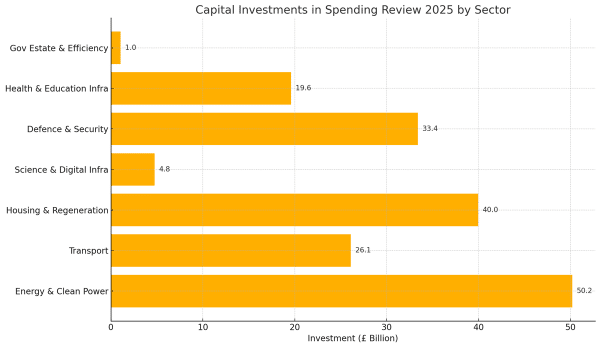
We highlight some of the projects/initiatives here:
Energy and Clean Power
- Sizewell C – £14.2bn for nuclear power station construction.
- Small Modular Reactors (SMRs) – Over £2.5bn for rollout infrastructure; capital intensive.
- Fusion Prototype Plant (Nottinghamshire) – Within the £2.5bn advanced nuclear allocation; facility construction.
- Carbon Capture, Usage and Storage (CCUS) – £9.4bn over the SR period; capital deployment on capture facilities and transport/storage systems.
- Warm Homes Plan – £13.2bn for physical insulation, heat pump and solar panel installations.
- Floating Offshore Wind Port (Port Talbot) – Up to £80m in infrastructure funding.
- Great British Energy (and GBE Nuclear) – £8.3bn+ to support new state-owned clean power assets and infrastructure.
Transport & Urban Mobility
- East West Rail – £2.5bn to complete connection between Oxford, Milton Keynes, Cambridge.
- Transpennine Route Upgrade – £3.5bn for heavy rail infrastructure works.
- Transport for City Regions (TCR) – £15.6bn by 2031–32 for metro infrastructure
- Local Transport Grant – £2.3bn for road layouts, bus lanes, cycleways.
- Transport for London – £2.2bn (2026–2030) for capital renewals (e.g., rolling stock, tracks).
Housing and Regeneration
- 10-Year Affordable Homes Programme – £39bn capital to build social and affordable homes.
- Local Authority Housing Fund – £950m capital to build/acquire temporary accommodation.
- Community Regeneration Programme – Capital regeneration in 350 deprived communities (amount not individually disaggregated).
- Local Growth Fund (North and Midlands cities) – Includes 10-year capital settlements to support the wider programme of devolution to mayoral authorities.
Science, Innovation & Digital Infrastructure
- UK Supercomputer (Edinburgh) – £750m to build and operate a national compute facility.
- AI Research Compute Expansion – Physical infrastructure for AI model training at 20x current capacity.
- Advanced Research and Invention Agency (ARIA) – At least £1bn; capital facilities and lab construction embedded.
- National Data Library – Expected to include digital infrastructure.
- GOV.UK Wallet and App – Capital project under digital infrastructure modernisation.
Defence and National Security
- Nuclear Warhead Production Programme – £15bn in capital for factory construction and modernisation.
- Directed Energy Weapons Programme – £1bn investment in physical systems.
- Autonomous Drone Swarms Programme – £4bn total (including £2bn new capital allocation).
- Munitions Factories – £6bn for new arms production facilities.
- Military Infrastructure Renewal – £7bn for family housing and base upgrades.
- UK Defence Innovation Unit – Portion capital (facility and equipment, though some spend may be operational).
Health & Education Capital Projects
- NHS Technology and Digitisation Programme – Up to £10bn; capital includes IT hardware, data centres, digitisation infrastructure.
- School Rebuilding Programme – £2.4bn annually to rebuild or refurbish 500 schools.
- School-Based Nurseries Expansion – Includes capital element in £370m commitment.
What next?
The 2025 Spending Review contained some explicit commitments to a wide range of major projects whilst also sign-posting that further announcements and reform will be included in the upcoming 10-year National Infrastructure Strategy and the Industrial Strategy – both expected by the end of June. We’ll take a deep dive into these papers as soon as they are published and share our thoughts on the implications for major projects.
The other thing we spotted in the 2025 Spending Review is the greater need for joined up thinking – how our major projects are interconnected with existing systems and other initiatives. It’s interesting that the term ‘agglomeration’ appears quite a few times, recognizing that the value of a portfolio is more than the sum of its parts – something that superstar Economist and Infrastructure guru Bridget Rosewell CBE will no doubt explore at our upcoming Prestige Lecture in July and a theme we will be taking into our Annual Conference in October. More on that later!