


Published
The second of a series of guest blogs provided by Bentley Systems. In the first post, Mark Coates and Andrew Foster look at how Singapore has embraced the concept of the digital twin. In this new post, Mark Coates and Andy Willetts turn their focus to the renaissance of light rail since the turn of the century.
 Since 2000, across the world, 108 cities have opened their first line. Now, light rail is available in 389 cities across the world, according to the International Association of Public Transport (IAPT). Additionally both the amount of light rail transit (LRT) infrastructure and the number of riders had been growing rapidly in the years before the COVID-19 pandemic struck.
Total patronage was up by 4.8% in the three years to 2018, with a total of 14.7 billion passengers worldwide. The 2,304 light rail lines in the world now cover 15,847 kilometers. Laid end to end, they would stretch more than a third of the way around the globe.
The light rail renaissance has been a global phenomenon, by and large. While Europe remains the world’s undisputed “tram capital,” China has recently seen huge investment in light rail. While passengers enjoy the speed and convenience of metros, they are expensive and time-consuming pieces of infrastructure to plan and build, even when taking into account China’s rapid construction rates. Metros are also expensive to run when they are in service, with many Chinese systems in keeping with the rest of the world running at a loss. As a result, city officials in China are looking for more affordable solutions to solve their transport challenges.
Light rail offers a cost-effective alternative, with construction costs at just 20% to 30% the cost of building a metro line. The upshot is that IAPT figures show that in 2018, the Asia-Pacific region reached an important milestone—the first year that more new light rail track was laid in Asia-Pacific than in Europe.
Nonetheless, Europe currently accounts for roughly three quarters of the world’s tram passengers each year—more than 10 billion—as well as eight of the ten busiest networks (Budapest, Prague, Vienna, Paris, and Warsaw make up the global top five, followed by Hong Kong, Cologne, Zurich, Melbourne, and Berlin).
Why has this happened? It is easy to see the appeal of light rail to urban planners, as well as treasury officials. Trams offer a more predictable, less polluting mass-transit alternative to relying on buses, as well as being cheaper and easier to build than underground rail.
However, there are less quantifiable benefits, too: trams make cities more attractive to businesses and residents alike. As Eurogroup Consulting put it in a recent report, “Trams enhance the urban landscape and modernise neighbourhoods by transforming public space.
 “Trams contribute to neighbourhood cohesion and reassure investors by illustrating an area’s investment appeal. Trams can also reflect the image and identity of the city.”
Since all this is true—and to be welcomed—it would be easy to run away with the idea that trams are “the solution” to “the problem” of modern urban transport. But the reality is somewhat more complex. Even in Melbourne—the city with the largest LRT network in the world—more people take the train than take the tram.
Trams can indeed play a vital role in our cities’ transport networks, but they are rarely a single solution. And if they are to function as networks themselves, they take time (and money) to evolve. Far more crucial is how they fit into the overall transport system.
Consider the experience of the U.K. There are a number of LRT systems in cities outside London, but their size varies significantly.
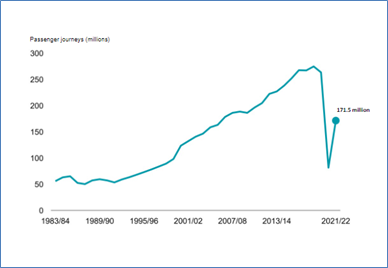
As the chart shows, in the year ending March 2022, light rail and tram use in England more than doubled from the year ending March 2021, up to 171.5 million passenger journeys. However, it remained well below pre-pandemic levels.
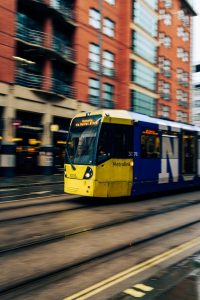 The Manchester Metrolink system is perhaps the most successful in recent years, and is the U.K.’s only representative on the list of 23 light rail systems across the world with more than 100 kilometers of track. It has grown rapidly since 2000, although not without struggle—the so-called “Big Bang” expansion, which saw the building of four new lines, came about only after a protracted battle for funding from the, then, Labour government.
Growth in other city-regions has been slower, as well as less extensive. The Tyne and Wear Metro has had 78 kilometers of track since 2001-2002. The West Midlands is finally going to triple in size as part of a GBP 1.3 billion investment package, having featured just one 20-kilometer line since its launch in 1999. Nottingham Express Transit has 32 kilometers of track, Sheffield Supertram has 34 kilometers, Blackpool Tramway has 18 kilometers, and Edinburgh Trams has 14 kilometers.
Most of those “systems” are not really networks, but rather individual lines carrying passengers along popular commuting corridors. Even in Budapest, the tram is not king when it comes to public transport. While Budapest’s tram lines carry almost 100 million more passengers annually than the Budapest Metro, it is still only the city’s second most popular public transport system after buses.
Across the Greater Manchester city-region, there were 44.3 million Metrolink passengers in 2019-2020, compared to 177.9 million bus journeys—a ratio of more than four to one in favour of the bus.
In the U.K., since buses were deregulated outside London in 1986, council leaders and mayors in other conurbations have had little control over when and where those services have run. This situation has made multi-modal route-planning and integrated ticketing all but impossible.
The mayor of Greater Manchester, Andy Burnham, recently won a court case that effectively gives him the power to re-regulate buses. This decision paves the way for cheaper fares, better integration between tram and bus services, and London-style multi-mode ticketing. It is a development that promises to be far more transformative for public transport in Manchester than simply adding more miles of tram-track.
Tram systems are also somewhat constrained by capacity issues—there are limits to the speed at which trams can run, and the total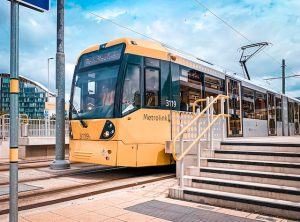 number of services. In total, the U.K. has 367 kilometers of tram and light rail outside London, slightly less than the total amount of track that makes up the London underground (414 kilometers). Yet, there are 11.2 journeys on the London Underground for every one on those 367 kilometers of provincial LRT.
Political leaders and planners looking for clean, efficient mass urban transport are right to be looking at light rail. However, building a functioning network—which takes a significant bite out of commuter movements every day—takes time as well as money. The key parameters involved in determining a public transport solution are travelling time, capacity, and price. How long does it take commuters to get to their destination? What is the maximum number of passengers? And what does it cost to build and run? With a surge in urbanisation, it is increasingly important to evaluate how different areas of cities are to be serviced by public transport.
Light rail systems are part of a far-sighted development strategy and create a sense of stability that allows for an increase in urban density and development. In the wider urban picture, light rail then becomes a tool—cheaper but with less capacity than metros and trains, and more expensive than buses but with more emphasis on capacity, speed, and comfort.
For it to be effective, it should be implemented when it has a meaningful role to play in an urban environment. Even then, it is crucial that light rail is seen as only one voice in a choir that must sing together. Other modes of transport—including walking and cycling routes, as well as buses and rail services—must be properly integrated with tram networks if the benefits of light rail are to be properly realised.
More about Metrolink and the Future of Rapid Transit in Manchester
More about the Budapest Tram and Trolley Bus System
Related resources
About the Authors
Mark Coates is International Director of Public Policy and Advocacy at Bentley Systems and a Strategic Board Member for the Digital Twin Hub.
Andy Willetts is Senior Account Manager, Mobilty, Northern Europe