


Published
The recent Association Roundtable looking at Systems Integration through the lens of the IPA Project Routemap offered some brilliant real world examples of the challenge of systems integration and fleshed out what it actually involves.
I’ve captured some of the themes from the discussion in an infographic (below).
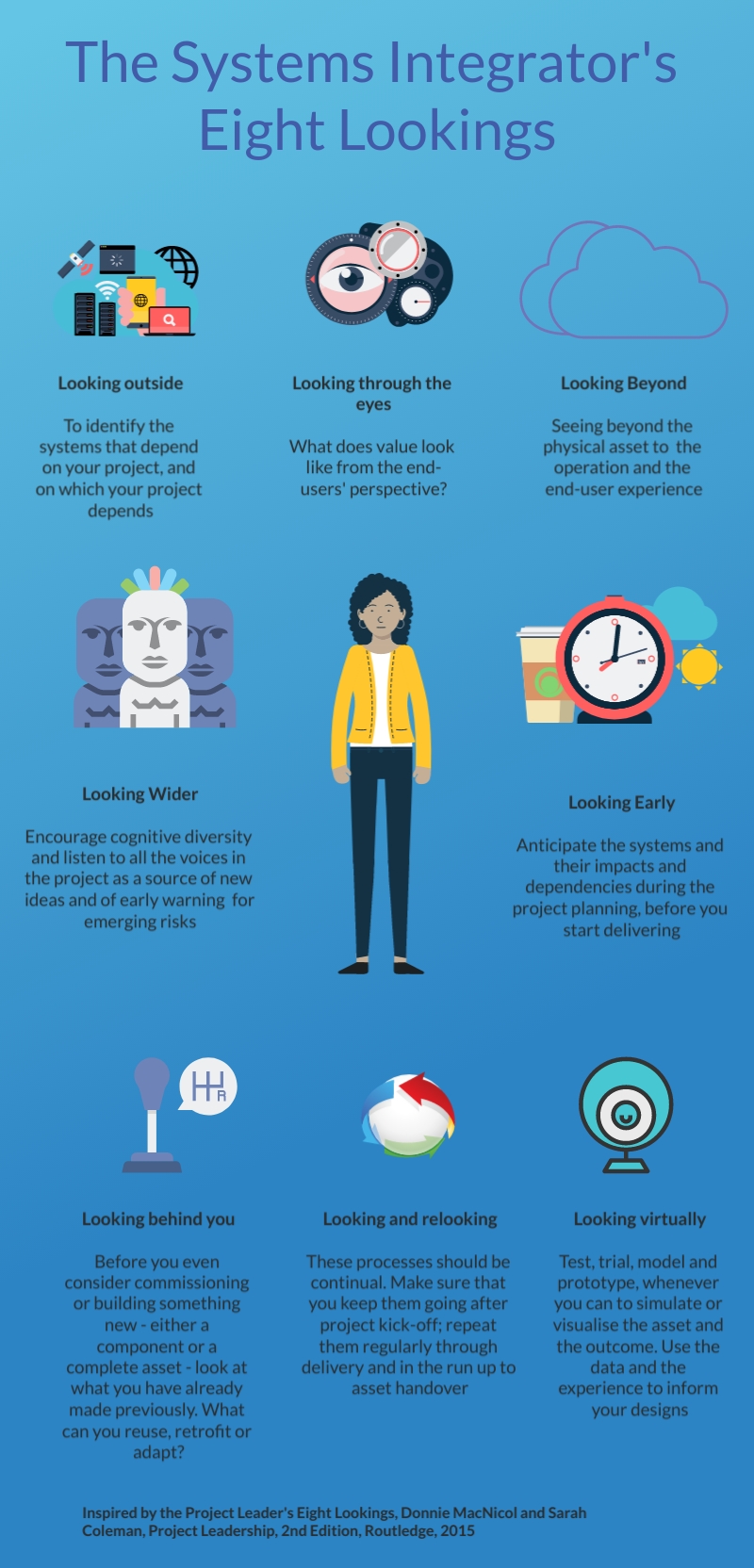
Being able to visualise and represent systems and their interactions is an important element of systems integration, whether that be through the medium of BIM or other simulation software or through the rich pictures that Melissa Zanocco shared with us of the nature of systems in the built environment. I hope that this simple visual will spark some reflections for you.
I am indebted to Donnie MacNicol and Sarah Coleman’s work in the 2nd edition of Project Leadership, where they shared the concept of the project leaders eight lookings, which provided the inspiration for this infographic. You can see an article on capable leadership on the RICS website, where Donnie explains the idea.
Further resources
You can find further information on systems integration and on the ideas we explored during this Roundtable from the following links:
The Systems Integration Module in the IPA’s Project Routemap
To maximise economic, environmental, and social benefit, effective systems integration establishes a clear and continuous line of sight between individual systems delivered by a project, how these are brought together, and their subsequent incorporation within the overall system of systems to which they contribute. This module can help to assess whether existing or proposed systems integration arrangements are suitable for the scale and the complexity of your project.
The Project Delivery Capability Framework
Also from IPA, the PDCF describes the job roles, capabilities and learning for all Government Project Delivery Professionals across Government. As such it provides a picture of the roles and capabilities associated with Systems Integration.
A Research Agenda on Systems Approaches to Infrastructure
The authors of this paper argue for a change in current approaches to infrastructure: starting from the natural environment and its resources, encompassing societal use of infrastructure and the supporting infrastructure assets and services. To support such proposed new systems approaches to infrastructure, researchers need to develop novel modelling methods, forms of model integration, and multi-criteria indicators.
The Gemini Papers
Digital twins are part of the growing toolkit of approaches for mapping, understand and managing systems integration. The Gemini Papers set the Centre for Digital Built Britain’s vision for the future, showcasing the vital role that connected digital twins play in improving social, economic, and environmental outcomes, to create a better quality of life for all.