


Published
As part of my review of the Association’s archive I have come across a brilliant report from 2003: Learning from Project Failures, which introduced me to a new model of learning that I hadn’t come across before and which I wanted to share with you: The Nonaka Model of Spiral Learning.
This model helps explain the relationship between tacit and explicit knowledge and how they need to be combined for real learning to take place.
Explicit knowledge is defined as “what is readily available”, in other words, is recorded in manuals, reports or designed into organizational and project processes; a lot of the technical project management knowledge is explicit, as is scientific or engineering knowledge. Tacit knowledge is gained from experience, resides in people and is hard to share because it requires observation, imitation and practice, rather than simply reading or telling.
The Nonaka spiral is based around a classic two by two matrix:
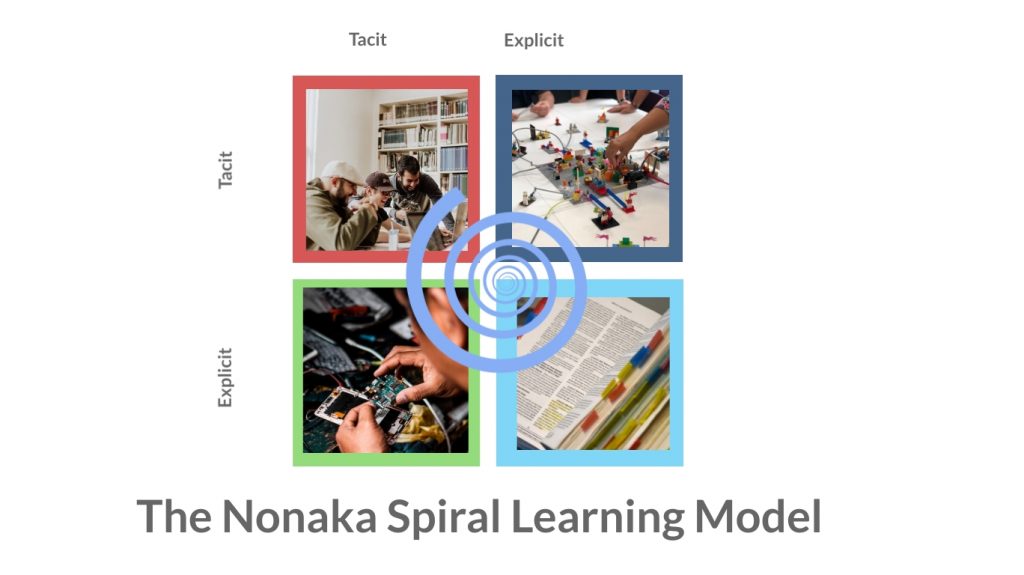 and describes the four types of knowledge transmission.
- Tacit to tacit – which involves socialization – talking with, observing and interacting with others so we can model their behaviour. Informal lunchtime learning talks from colleagues are a great way of doing this.
- Tacit to explicit – which is all about analogies, models, metaphors and requires that you externalize your ideas – anyone who has taken part in a Lego Serious Play exercise will understand this.
- Explicit to explicit – which involves combining and connecting new knowledge with your current understanding and can be done through a lessons learned system or simply reading a manual or a process description.
- Explicit to tacit – which requires you internalize what you are doing and create new heuristics. This is all about reflective, learning- by-doing; the kind of reflective practitioner activity that we often advocate for project professionals.
Learning from project failures (and indeed from our successes) is difficult because according to Nonaka, true learning involves all four elements – hence the spiral. Which means that if your knowledge management and lessons learned processes are missing part of this puzzle, then your chances of turning your employees into learners are likely to be limited.
The main role of the organization in this whole process is to create the right environment and space for learning by:
- encouraging open conversations, connections and networking;
- facilitating experimentation and providing opportunities for employees to explore and try out new skills through secondments, development centres and the like;
- allowing time for reflection and using techniques such as pre-mortems as well as after-action reviews imaginatively
and, equally importantly, an organizationneeds to take the time and resources to “understand exactly what knowledge assets are and have a vision for the kind of knowledge we require.”
Which brings me back to the original question in the headline of this blog. Are you confident you can answer it coherently, in terms both of your organization and in terms of the project(s) on which you are currently working.
Read the 2003 report: Learning from Project Failures.