


The Grammar of Systems
Summary
There is a grammar to complexity and systems thinking. One that can be learnt and for which the individual elements are useful in their own right. Over the coming weeks, we will be exploring these elements with a capable language guide, Patrick Hoverstadt of Fractal Consulting.
Let’s start by setting the context:
and introduce the first of the 33 tools,: The Viability Principle.
The second principle to which Patrick introduces us is that of the Conservation of Adaptation – essentially the fact that in a complex project, the only constant is change itself.
The third principle, The Law of Reciprocity of Connections explains why reactions you generate through your project activities will inevitably come back to bite you (so be prepared).
Confusingly, our fourth principle, is something called Adams’ Third Law. Which is wonderfully counter-intuitive and explains how risk works in a complex system.
Major projects are often structurally complex. How this complexity behaves is the subject of Patrick Hoverstadt’s latest short video on Principle Five: Root Structuration Theorem.
We’re rattling through the 33 laws and principles that make up the Grammar of Systems. This latest one is Self-Organising Principle and explains how elements, groups and individuals naturally start to connect once they come together.
“You’re in a race between what’s needed changing and how fast you can nail stuff down.” If you’ve got that sinking feeling that it’s all running away from you, then you may be experiencing the principle of Self-Organised Criticality.
Order Osmosis Principle: “The attention and the resources migrate from the difficult bits to the stuff that’s more stable, which means that the things that are ‘slightly flappy at the moment’ become even difficult to deal with.”
In the final video in our current series, Patrick explains how to start using the Grammar and reiterates their relevance for major projects.
Patrick Hoverstadt
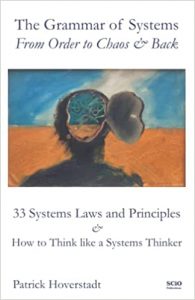 Provides consultancy mainly in organisation design, strategy, business architecture and organisational change using systems approaches. He has developed a set of methodologies that provide different approaches for: organisational change, performance management, strategic risk, strategy, partnership governance and organisational agility. In his spare time he does a bit of academic work, for Manchester Business School and the OU and is a visiting Research Fellow at Cranfield. Patrick wrote Fractal Organisation published by Wiley, the section on the Viable Systems Model in the OU’s course text Systems Approaches to Managing Change and contributions to a number of other books on management and organisation. Together with his co-author, Lucy Loh, he published Patterns of Strategy with Gower – a book outlining a radically different and systemic approaches to business strategy. Most recently, he has published: The Grammar of Systems – From Order to Chaos and Back.